How Stacking Solar, Batteries, and Heat Pumps Cuts Bills
Recent news reports highlight why standalone green tech often underperforms, and how integrating solar, storage, and heat pumps unlocks major household energy savings.
- Written by
- Net Zero Home Scheme editorial team
- Last updated
- Topic
- solar pv, heat pumps, battery storage

In July 2026, several industry reports re-examined the financial reality of UK household decarbonisation. On 20 July 2026, Energy Live News reported on research showing that combining low-carbon technologies could reduce household energy bills by more than 80%, compared to much smaller reductions from standalone upgrades. On the same day, Yahoo News UK published an analysis detailing why standalone heat pumps often deliver smaller savings than householders expect when operated on standard flat-rate electricity tariffs. Additional reporting from Lombard Odier on 28 July 2026 highlighted how domestic solar installations continue to buffer households against broader energy market volatility.
These publications point to a clear trend in UK home energy: isolated equipment upgrades yield modest financial returns, but co-ordinating generation, storage, and heating technologies fundamentally alters home energy economics.
What recent analysis shows about single versus stacked technology
To understand why standalone systems can underperform, it is necessary to examine the spark spread. Under Ofgem price cap figures, domestic electricity costs approximately 24.5p per kilowatt-hour (kWh), whereas mains gas costs approximately 6.2p per kWh. A modern air source heat pump operates with a Seasonal Coefficient of Performance (SCOP) between 3.0 and 3.8. This means that for every 1 kWh of electricity consumed, the heat pump yields 3.0 to 3.8 kWh of space heating or hot water.
When an efficient heat pump with an SCOP of 3.2 replaces a standard gas boiler operating at 85% efficiency, the running costs are often quite similar if the heat pump relies entirely on peak flat-rate grid electricity. The heat pump delivers substantial carbon savings, but the financial benefit remains modest.
When you stack technologies, the calculation shifts. Adding rooftop solar photovoltaics (PV) allows you to power the heat pump directly during daylight hours with self-generated electricity costing zero additional pence per kWh. Adding a home battery storage system lets you store daytime solar generation for evening heating demands, or charge the battery overnight using off-peak time-of-use tariffs that lower electricity costs to between 7p and 12p per kWh.
How technology integration alters household energy flows
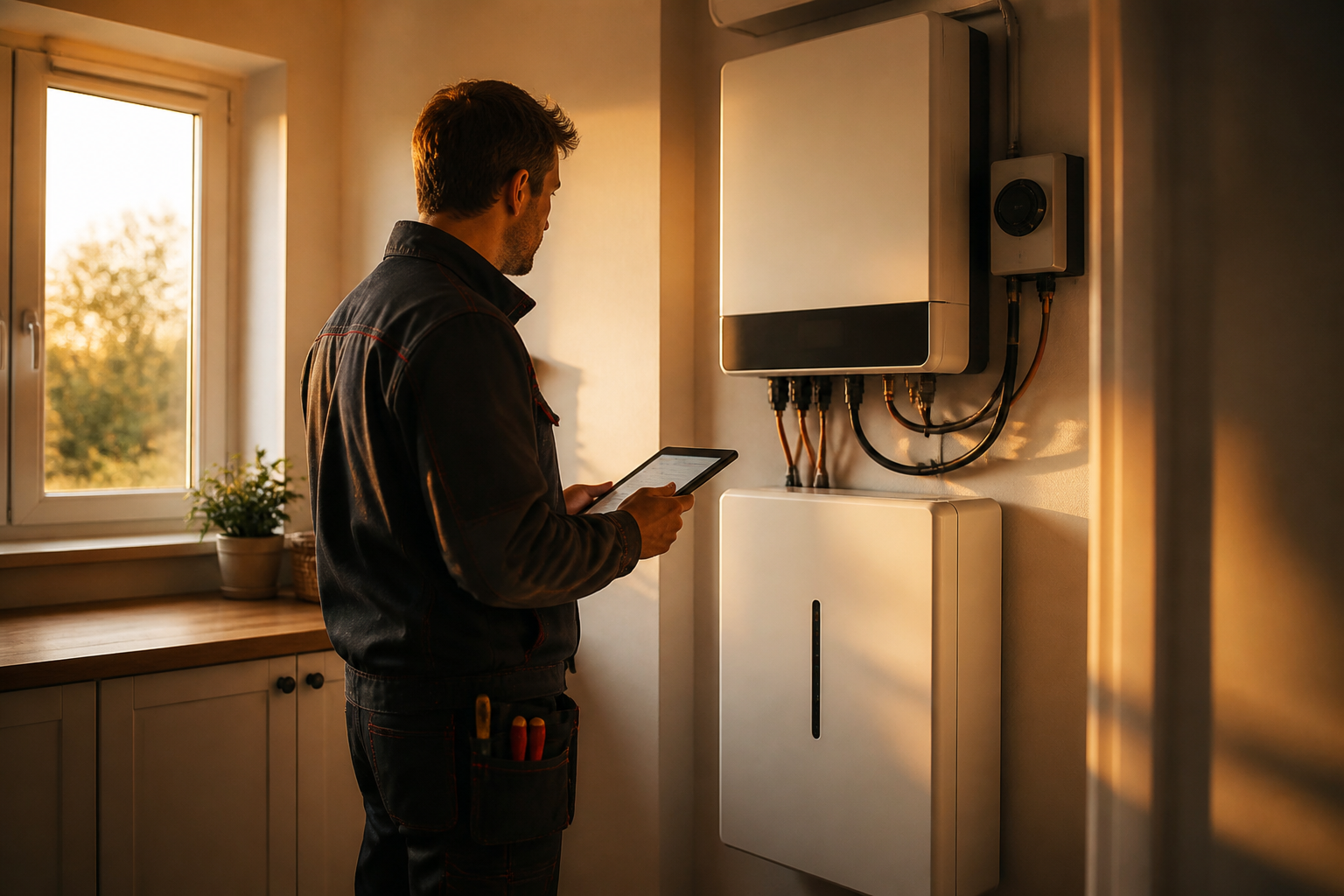
Here is a breakdown of how standalone installations compare to integrated whole-house systems based on industry data and operational metrics:
| Metric | Standalone Solar PV (4 kWp) | Standalone Heat Pump (SCOP 3.2) | Integrated System (Solar, 10 kWh Battery, Heat Pump) |
|---|---|---|---|
| Typical self-consumption rate | 30% to 40% | N/A (Grid dependent) | 70% to 80% |
| Primary source of space heating power | N/A | Peak grid electricity | Solar generation and off-peak battery storage |
| Average effective electricity unit cost | Flat rate (approx 24.5p/kWh) | Flat rate (approx 24.5p/kWh) | Blended rate (approx 8p to 12p/kWh) |
| Grid dependence during peak hours (4pm-7pm) | High (unless generating) | High | Minimal (runs on battery storage) |
| Typical annual bill reduction range | 25% to 35% | 0% to 15% relative to gas boiler | 60% to 80%+ subject to home heat loss |
Technical requirements and practical constraints
Combining these systems requires careful design and strict compliance with UK electrical and building standards. You cannot simply connect high-demand appliances together without evaluating your home supply capacity and regulatory permissions.
- Grid Connection Approvals: Solar PV systems over 3.68 kW single-phase capacity or batteries capable of exporting significant power require prior Distribution Network Operator (DNO) approval under Engineering Recommendation G99. Smaller systems operate under the faster G98 notification process.
- Certification Standards: Heating installations should be completed by Microgeneration Certification Scheme (MCS) accredited installers to ensure eligibility for government incentives such as the Boiler Upgrade Scheme. Electrical work must comply with BS 7671 standards and be carried out by certified competent persons registered with bodies like NICEIC.
- Smart Meter Infrastructure: To take advantage of dynamic or time-of-use tariffs, your home must have an operational SMETS2 smart meter capable of half-hourly meter readings sent directly to your energy supplier.
- Consumer Protection: Ensure your installer is registered with TrustMark and a consumer code such as the Renewable Energy Consumer Code (RECC) or Home Insulation and Energy Systems Contractors Scheme (HIES).
What this means for you
If you are planning home energy improvements, recent news analysis suggests shifting focus from isolated upgrades to a phased, integrated strategy.
- Assess your fabric efficiency first: Heat pumps operate most efficiently in homes with low heat loss. Upgrading loft and cavity wall insulation lowers the flow temperature your heat pump requires, directly improving its SCOP.
- Pair heating upgrades with dynamic tariffs: If you install a heat pump without solar, switching to a heating-specific time-of-use tariff can lower running costs substantially compared to standard variable rates.
- Size storage to seasonal demand: A battery sized only for summer solar capture may be underutilised in winter. Ensure your battery management system supports automated overnight grid charging to maximize winter savings.
- Explore employer support schemes: Employers across England, Scotland, and Wales can offer access to discounted home technology through the Net Zero Home Scheme, which delivers member pricing on accredited solar, battery, heat pump, and tariff packages with no salary sacrifice or payroll deductions involved.
Frequently asked questions
Do I need to install all low-carbon technologies at the same time?
No. Many households adopt a phased approach, starting with solar PV and a smart meter, adding battery storage next, and later installing an air source heat pump once heating controls and insulation are optimized. Ensuring your solar inverter is battery-ready or choosing a modular battery architecture allows straightforward retrofitting without replacing earlier equipment.
Why does electricity pricing affect heat pump savings so heavily?
Because UK grid electricity prices are historically tied to wholesale gas generation costs under marginal pricing rules. Because electricity carries higher green levies and distribution charges than mains gas under current policy, electricity per kWh costs significantly more than gas. High heat pump efficiency (SCOP) bridges this gap, but lower electricity tariffs or self-generated solar power are required to achieve major financial savings.
Can plug-in solar panels integrate with a home battery system?
Plug-in solar panels provide modest supplemental generation, typically capped at 800 watts to conform to standard socket safety standards. While they can offset daytime background electricity loads, they generally operate independently from integrated whole-home battery and heat pump management systems, which require hardwired connections and dedicated consumer unit circuits.