Weather Compensation Controls: Physics, COP and Energy Savings
How weather compensation curves adjust heat pump flow temperatures based on external weather, boosting Carnot efficiency, improving COP, and reducing energy bills.
- Written by
- Net Zero Home Scheme editorial team
- Last updated
- Topic
- heat pumps, energy efficiency, energy bills
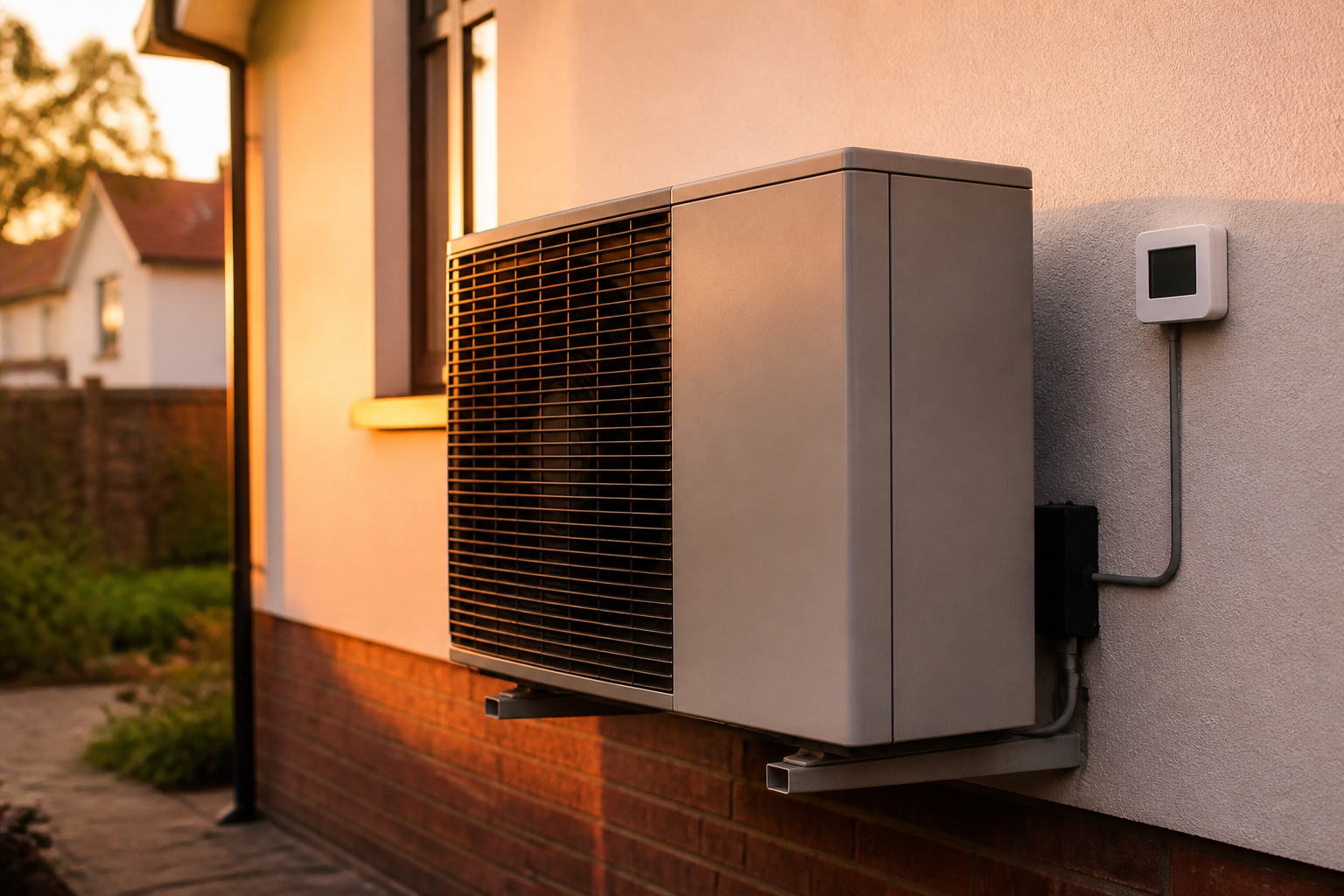
Many UK householders replacing traditional gas boilers with heat pumps expect heating controls to operate on demand, where a boiler fires water at 65°C or 70°C whenever a wall thermostat calls for heat. Heat pumps operating in this intermittent, high-temperature manner lose significant efficiency. Weather compensation, standard on modern heat pump installations installed to Microgeneration Certification Scheme (MCS) standards, fundamentally changes how heat is delivered. Rather than firing at a fixed maximum water temperature, weather compensation continuously adjusts the flow temperature feeding radiators or underfloor heating based on external weather conditions. Understanding the thermodynamic physics and financial return behind this control method reveals why automated flow management is central to lowering running costs.
The Physics of Heat Pump Efficiency and Temperature Lift
Air source heat pumps transfer thermal energy from outside air into a building's water circuit using a vapor compression refrigeration cycle. The physical efficiency of this process is governed by thermodynamic principles derived from the theoretical Carnot cycle. A heat pump's efficiency is expressed as its Coefficient of Performance (COP), which measures the ratio of useful heat output to electrical energy input.
The key variable governing COP is temperature lift, defined as the difference between the source temperature (the outdoor air) and the sink temperature (the flow water temperature entering the home's heating distribution pipework). Mathematically, as the temperature lift increases, the mechanical work required from the refrigerant compressor rises exponentially. Conversely, shrinking the temperature lift dramatically reduces electrical power consumption.
According to technical guidance from the Energy Saving Trust and the Heat Pump Federation, for every 1°C reduction in flow water temperature, the COP of an air source heat pump improves by approximately 2% to 2.5%. When outdoor ambient temperatures rise from -3°C on a freezing winter morning to 10°C on a mild autumn afternoon, a house loses heat through its walls and roof at a much slower rate. A fixed 50°C flow water system forces the compressor to deliver high temperature lift even when heat demand is minimal, wasting energy. Weather compensation drops the flow water temperature to 35°C or lower on mild days, raising the instant COP from roughly 2.8 to over 4.2.
How Weather Compensation Curves Work in Practice
To operate weather compensation, an external temperature sensor (a thermistor) is installed on a shaded exterior wall, usually facing north or north-east to avoid direct solar heating. This sensor feeds real-time ambient outdoor temperature readings back to the heat pump's central controller.
The controller calculates the exact required flow water temperature using a pre-programmed mathematical relationship known as the weather curve or heating curve. This curve is defined by two primary parameters set during commissioning:
- The Slope or Gradient: The slope determines how aggressively the flow temperature increases as outdoor temperatures drop. Modern radiator systems designed for low-temperature operation typically use a slope between 1.0 and 1.3, resulting in a flow temperature of 35°C at 12°C ambient, rising to 50°C at -3°C ambient. Underfloor heating systems, which have larger surface areas, use a gentler slope between 0.4 and 0.6.
- The Offset or Base Shift: The offset shifts the entire heating curve up or down by a set number of degrees. Installers use offset adjustments to fine-tune indoor comfort if a home feels consistently too cool or too warm across all outdoor temperatures.
By continuously tracking outdoor air, the heat pump modulates its compressor speed to match thermal output with building heat loss in real time, avoiding the wasteful stop-start cycling typical of fixed-temperature heating.
Weather Compensation vs Fixed Flow Controls
| Control Strategy | Water Flow Temperature Logic | Average Seasonal COP (SCOP) | Typical Heating Pattern | Annual kWh Impact | Compressor Wear |
|---|---|---|---|---|---|
| Fixed High Flow | Constant 50°C to 55°C regardless of weather | 2.5 to 2.9 | Short, intense bursts at high power | Highest electricity consumption | High due to frequent cycling |
| Fixed Low Flow | Constant 40°C set point year-round | 3.0 to 3.3 | Continuous run on mild days, underheats in freezing weather | Moderate electricity consumption | Moderate |
| Weather Compensation | Dynamic 30°C to 50°C based on outdoor sensor | 3.4 to 4.1 | Continuous low-temperature trickle heating | Lowest space heating electricity consumption | Low due to long modulation runs |
| Smart Compensated | Dynamic flow curve plus indoor feedback and dynamic tariffs | 3.6 to 4.3 | Automated load shifting with low flow temperatures | Minimal financial bill cost | Low |
Practical Trade-offs, Counter-Arguments and Limitations
While weather compensation provides clear thermodynamic advantages, it introduces operational trade-offs that householders and installers must manage:
- Slower Thermal Response and Warm-Up Times: Lower flow water temperatures transfer heat into rooms at a slower rate. If a property is allowed to cool down significantly during an overnight setback, raising the indoor temperature from 15°C to 20°C can take hours on a mild day because the weather compensation system intentionally limits the flow temperature. Successful weather compensation relies on continuous trickle heating rather than rapid intermittent boosts.
- Emitter Sizing Requirements: In properties fitted with traditional, small Type 11 single-convector gas boiler radiators, lowering flow temperatures to 35°C on mild days may fail to deliver adequate convective heat. Retrofitting larger Type 22 or Type 33 double-convector radiators is often necessary to maximize the benefits of low flow temperatures, adding up-front capital expense.
- User Perception and Wall Feel: Homeowners accustomed to gas boilers often expect radiators to feel scorching to the touch. Under weather compensation, radiators frequently feel lukewarm (32°C to 38°C), leading some users to mistakenly believe the system is failing and manually override the automated controls, which degrades seasonal performance.
- Sensor Placement Sensitivity: External sensors mounted in direct sunlight, near kitchen extract vents, or close to heat pump exhaust plumes report inaccurate ambient temperatures, causing the controller to under-heat or over-heat the property.
What Evidence Shows About Cost and Carbon Savings
Empirical field trial data published by the Energy Saving Trust and monitored field reports evaluated by the Climate Change Committee demonstrate that optimizing heat pump flow temperatures via weather compensation delivers a seasonal efficiency gain of 12% to 18% compared to uncompensated thermostat cycling.
For an average UK home requiring 10,000 kWh of space heating per year:
- Operating at a fixed flow temperature yielding a Seasonal Coefficient of Performance (SCOP) of 2.8 requires 3,571 kWh of electricity annually.
- Enabling weather compensation to achieve an average SCOP of 3.6 reduces annual electricity consumption for space heating to 2,778 kWh, saving 793 kWh per year.
- Based on Ofgem electricity price cap benchmarks of 24.5p per kWh, this physical efficiency gain yields a direct financial saving of approximately £194 per year on heating bills while preventing around 150 kg of carbon dioxide emissions annually under current UK grid intensity levels.
What this means for you
If you have an air source or ground source heat pump, ensure weather compensation is enabled within your controller settings and that a physical outdoor temperature sensor is installed on a shaded north-facing elevation. Avoid using deep overnight temperature setbacks, as heating systems configured with weather compensation operate most efficiently when maintaining steady indoor temperatures over extended periods.
For employees considering home energy upgrades, workplace benefit schemes provide a simple route to accessing accredited installation teams. The Net Zero Home Scheme gives employees access to member pricing on heat pumps, solar PV, battery storage, and smart controls installed by accredited contractors across England, Scotland, and Wales.
Frequently asked questions
Do I still need a room thermostat if weather compensation is active?
Yes. While the weather compensation sensor sets the water temperature based on outdoor conditions, an internal room thermostat or room sensor provides a vital feedback loop. It trims or stops heating when internal heat gains occur, such as solar gain through south-facing windows, heat from cooking, or occupant body heat.
Why do my radiators feel lukewarm when weather compensation is working?
Lukewarm radiators indicate that weather compensation is functioning correctly. By running water at 32°C to 38°C rather than 65°C, the system delivers heat steadily to match the building's continuous heat loss, maximizing compressor COP and lowering electricity consumption.
Can weather compensation be added to an existing heat pump?
In almost all cases, yes. Modern heat pumps installed to MCS standards feature integrated weather compensation software. If an outdoor sensor was omitted during original installation, a compatible wired or wireless sensor can be retrofitted and commissioned by a qualified technician.
Sources
- Heat Pump Efficiency and Operating Controls, Energy Saving Trust
- MCS Heat Pump Design and Installation Standards, Microgeneration Certification Scheme
- Sixth Carbon Budget: Sector Summary Buildings, Climate Change Committee