Ground Source Heat Pumps: Physics and Economics
An operational guide to how ground source heat pumps extract solar thermal energy from soil, their efficiency gains over air source units, and key economic trade-offs.
- Written by
- Net Zero Home Scheme editorial team
- Last updated
- Topic
- ground source heat pumps, heat pumps, home decarbonisation
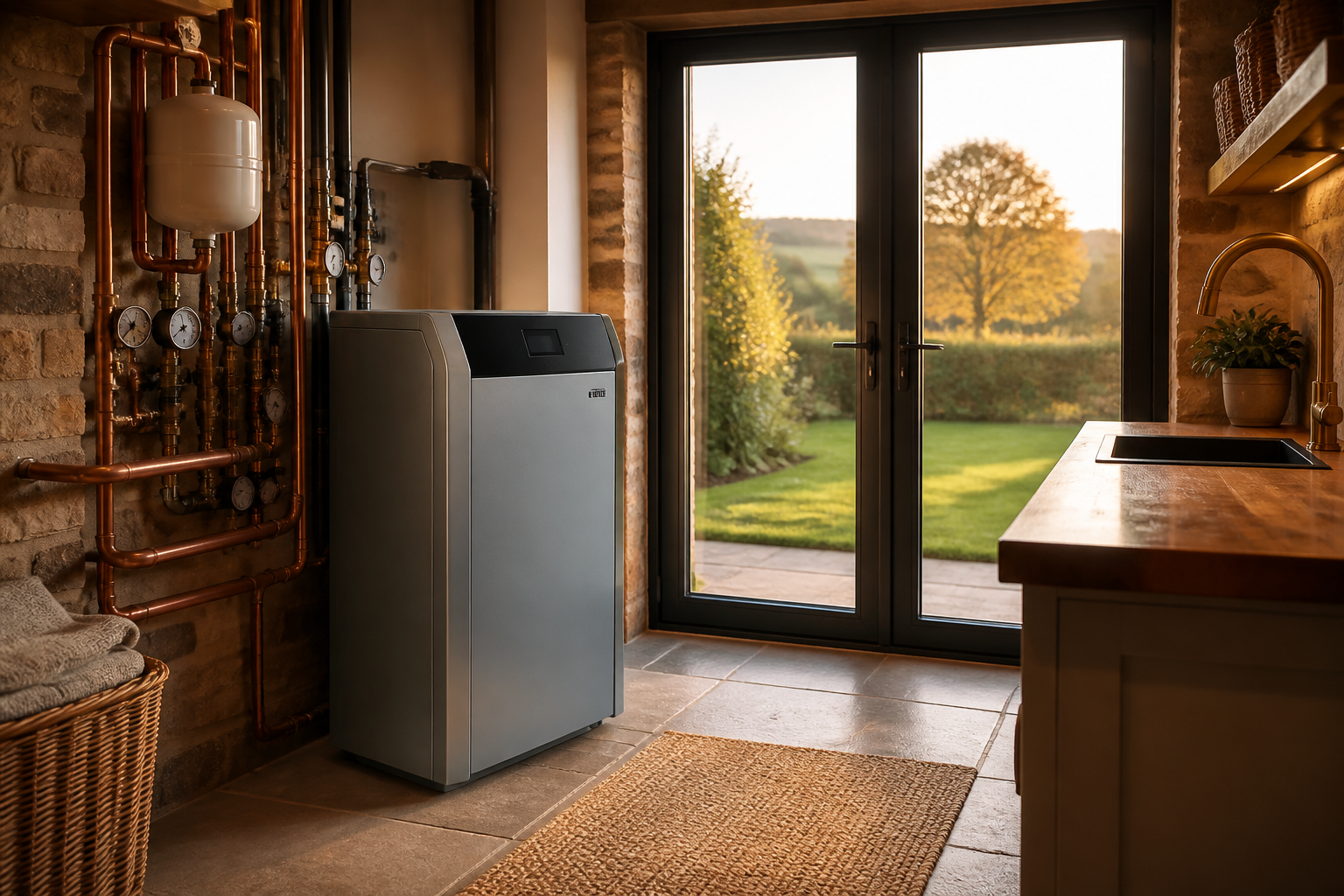
Ground source heat pumps transfer low-grade thermal energy stored in the earth into high-grade space heating and hot water for homes. While air source systems draw heat from ambient outdoor air, ground source heat pumps rely on the earth or groundwater beneath a property. In the UK, soil temperatures at depths below 1.2 metres remain relatively constant between 10 degrees Celsius and 12 degrees Celsius throughout the year, regardless of winter frost or summer warmth. This thermal stability creates distinct thermodynamic advantages, but it comes with higher capital costs and physical installation requirements.
How the physics of ground heat extraction works
The upper layers of the earth function as a massive solar collector and thermal battery. Heat energy from direct sunlight, rainfall, and ambient air transfers into the soil, creating a predictable underground temperature gradient. A ground source heat pump accesses this heat using a closed loop of durable polyethylene pipework buried underground.
A fluid mixture of water and non-toxic glycol antifreeze pumps through this subterranean network. As the cold fluid flows through the pipes, thermal energy moves from the warmer soil into the colder fluid through heat conduction across the pipe walls. The thermodynamic process follows three main steps:
- Evaporation: The warmed fluid returns to the indoor heat pump unit, passing through a heat exchanger where it transfers thermal energy to a liquid refrigerant. The refrigerant has a low boiling point and evaporates into a vapour at low temperatures.
- Compression: An electrically powered compressor squeezes the refrigerant vapour. Compressing a gas increases its pressure and dramatically raises its temperature, concentrating the low-grade heat into high-grade energy suitable for domestic heating.
- Condensation and Distribution: The hot refrigerant gas passes through a second heat exchanger, transferring its heat to the water circuit that feeds your radiators or underfloor heating system. The refrigerant cools, condenses back into a liquid, passes through an expansion valve, and repeats the cycle.
Seasonal efficiency and thermodynamic stability
The core thermodynamic advantage of ground source heating over air source heating lies in the differential temperature between the heat source and the heating distribution system. According to the laws of thermodynamics, heat pumps operate at higher efficiency when the temperature gap between the input source and output flow temperature is smaller.
Air source heat pumps must extract heat from outdoor air that can drop below zero degrees Celsius in winter, precisely when space heating demand is highest. To maintain indoor temperatures, an air source compressor must work harder, and the unit must periodically expend energy defrosting its outdoor evaporator coil.
Because sub-surface ground temperatures remain stable at 10 to 12 degrees Celsius during peak winter months, a ground source system operates with a much smaller temperature differential. According to data published by the Energy Saving Trust, a correctly specified ground source heat pump achieves a Seasonal Coefficient of Performance (SCOP) between 3.5 and 4.5. This means that for every 1 kilowatt-hour of electricity consumed by the compressor, the system generates between 3.5 and 4.5 kilowatt-hours of heat over an entire heating season. By comparison, typical domestic air source systems achieve an SCOP between 2.8 and 3.8 under UK climate conditions.
Collector configurations: Horizontal loops versus vertical boreholes
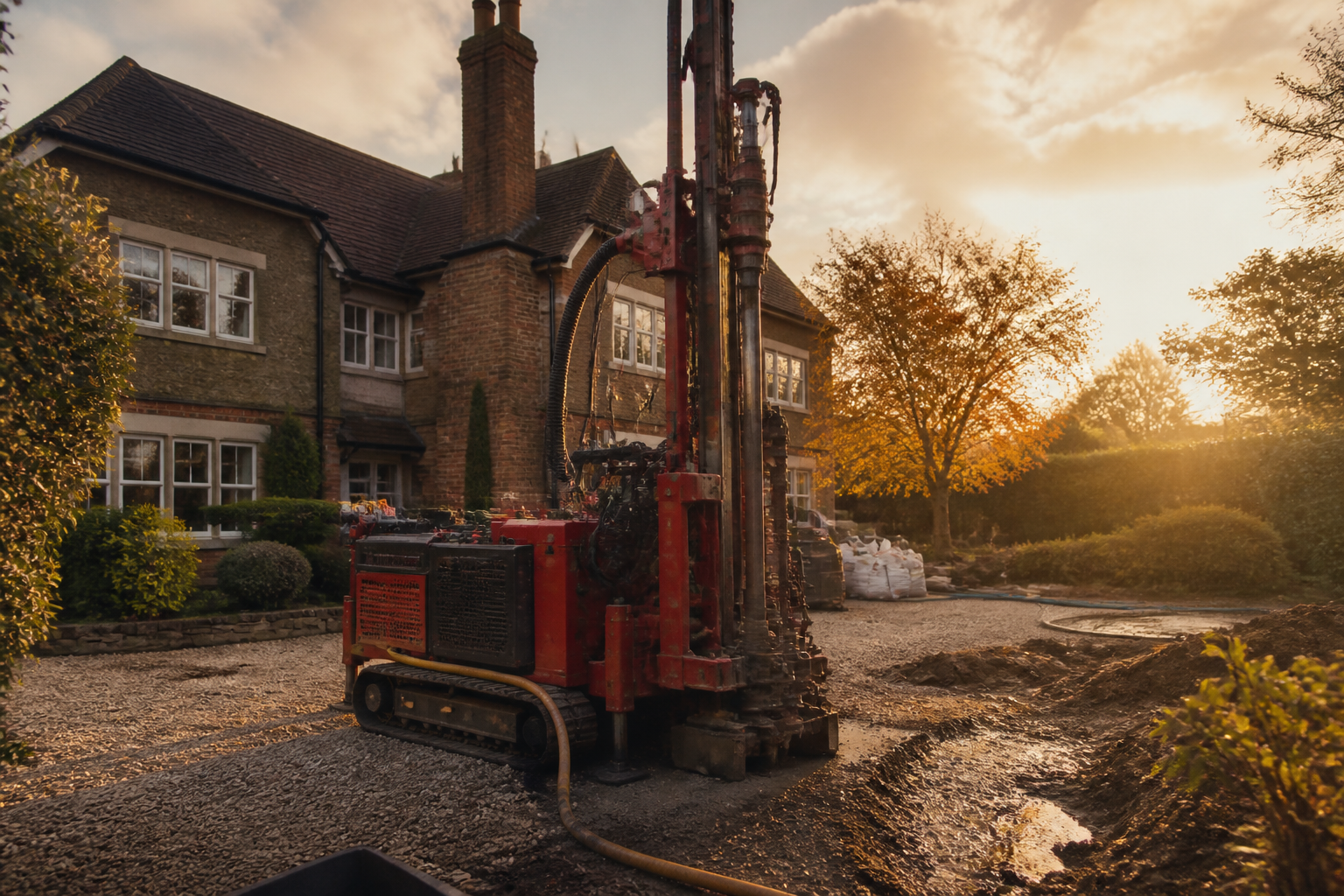
Extracting sufficient energy from the ground requires careful engineering to match the system's output to the heat loss profile of the building. Installers typically deploy one of two ground collector types, both governed by standards defined in MCS standard MIS 3005-D.
Horizontal ground loops
Horizontal collectors consist of long runs of pipe buried in shallow trenches at a depth between 1.2 and 1.5 metres. The pipes are laid either as straight runs or in overlapping coils known as slinkies.
- Land area: A horizontal system generally requires a land footprint two to three times the total internal floor area of the house.
- Soil conditions: Moist, dense clay soils conduct heat far more effectively than dry, sandy soils, reducing the total trench length required.
- Cost: Excavation is performed using standard diggers, making horizontal collectors cheaper to install than vertical boreholes.
Vertical boreholes
When land area is restricted, vertical boreholes are drilled into the earth to depths typically ranging between 50 and 150 metres. U-shaped collector pipes are inserted into the borehole, which is then sealed with conductive bentonite grout to ensure efficient thermal contact with the surrounding rock strata.
- Land area: Vertical boreholes require a minimal surface footprint, often no larger than a standard manhole cover per borehole.
- Consistency: Deep bedrock offers even more stable thermal conditions and higher heat transfer rates than shallow soil.
- Cost: Borehole drilling requires specialized rigs and geological surveys, substantially increasing the initial capital expenditure.
Economics: Comparing capital expenditure and running costs
While ground source heat pumps deliver superior seasonal efficiency, the economic case depends on weighing higher initial capital costs against lower annual electricity bills and long-term asset longevity.
The table below compares the physical requirements, operational performance, and estimated costs of different heating options based on technical parameters established by MCS and the Climate Change Committee.
| System Type | Typical Installed Cost Range | Average SCOP | Required Land Footprint | Expected Collector/Unit Lifespan |
|---|---|---|---|---|
| Horizontal GSHP | £18,000 - £25,000 | 3.5 - 4.2 | 200 - 500 sq metres | 50 years (loop) / 20 years (unit) |
| Vertical Borehole GSHP | £25,000 - £35,000 | 3.8 - 4.5 | Minimal (< 10 sq metres) | 50+ years (borehole) / 20 years (unit) |
| Air Source Heat Pump | £10,000 - £15,000 | 2.8 - 3.8 | Minimal (< 2 sq metres) | 15 - 20 years (complete unit) |
| Gas Condensing Boiler | £2,500 - £4,000 | 0.85 - 0.92 | None (indoor/wall mounted) | 10 - 15 years (complete unit) |
Because ground collector loops have an operational lifespan exceeding 50 years, the underground infrastructure outlasts multiple generations of heat pump units. However, the high upfront capital cost means the simple payback period relative to an air source heat pump can stretch to 15 or 20 years, depending on prevailing electricity tariffs and government grant levels.
Technical trade-offs and counter-arguments
Ground source heat pumps are not a universal solution for every UK home. Fairly evaluating the technology requires acknowledging several physical and practical constraints:
- Thermal drawdown: If an underground collector is undersized relative to the building's heat load, the heat pump will extract energy faster than solar radiation and groundwater can replenish it. Over time, the surrounding ground temperature drops, lowering system efficiency and, in severe cases, freezing the soil.
- Site disruption: Installing horizontal slinkies involves major earthworks, stripping gardens, and rendering land unusable for deep-root trees or permanent structures.
- High capital barrier: Even with government schemes such as the Boiler Upgrade Scheme providing grants, the remaining capital outlay for borehole drilling remains restrictive for many householders.
- Retrofit challenges: Like all heat pumps, ground source systems deliver water at lower flow temperatures (around 45 degrees Celsius to 55 degrees Celsius) than traditional gas boilers (65 degrees Celsius to 75 degrees Celsius). Homes with poor insulation or small panel radiators may require emitter upgrades to achieve comfort levels.
What this means for you
If you are evaluating home decarbonisation options, ground source heat pumps offer maximum electrical efficiency and long-term infrastructure stability, provided your property fits the physical requirements.
- Assess your land and geology: Determine whether your garden has sufficient unshaded area for horizontal trenches, or if driveway access permits a vertical drilling rig.
- Maximise building fabric efficiency: Improving roof and wall insulation reduces total peak heat demand, which allows for a smaller, less expensive ground collector loop.
- Choose accredited contractors: Ensure your designer and installer are registered with MCS and TrustMark, and that heat loss calculations conform to CIBSE guidelines.
- Explore installation options: Schemes like the Net Zero Home Scheme enable UK employees to access accredited installers and member pricing for heat pumps and home renewable upgrades through employer-supported benefits.
Frequently asked questions
How much land do I need for a horizontal ground loop?
As a general rule, a horizontal collector requires a land area between two and three times the internal floor area of the heated living space. For a 150 square metre house, you typically need 300 to 450 square metres of open, unshaded ground free from permanent structures or deep-rooting trees.
Will a ground source heat pump freeze the soil around the pipes?
If the system is correctly designed in accordance with MCS standard MIS 3005-D, the soil will not freeze permanently. Heat extracted during winter is replenished during spring and summer through solar radiation, rainfall, and thermal conduction from surrounding earth. Freezing only occurs if the ground loop is severely undersized for the property's heat demand.
How long do the underground ground loop pipes last?
The high-density polyethylene (HDPE) pipes buried in ground loops or boreholes are engineered for extreme durability, with an estimated operational lifespan exceeding 50 years. The mechanical indoor heat pump unit typically lasts between 15 and 20 years before needing replacement, meaning the underground infrastructure can serve multiple successive heat pump units.
Sources
- Heat Pump Guide and Efficiency Insights, Energy Saving Trust
- MCS Standards for Heat Pump Installation (MIS 3005-D), Microgeneration Certification Scheme
- Net Zero Heating and Efficiency Reports, Climate Change Committee