Installing an Air-to-Air Heat Pump in the UK: A Practical Guide
A practical UK guide to installing air-to-air heat pumps, covering costs, permitted development, F-Gas accreditation, installer questions and realistic timelines.
- Written by
- Net Zero Home Scheme editorial team
- Last updated
- Topic
- heat pumps, home energy, heating
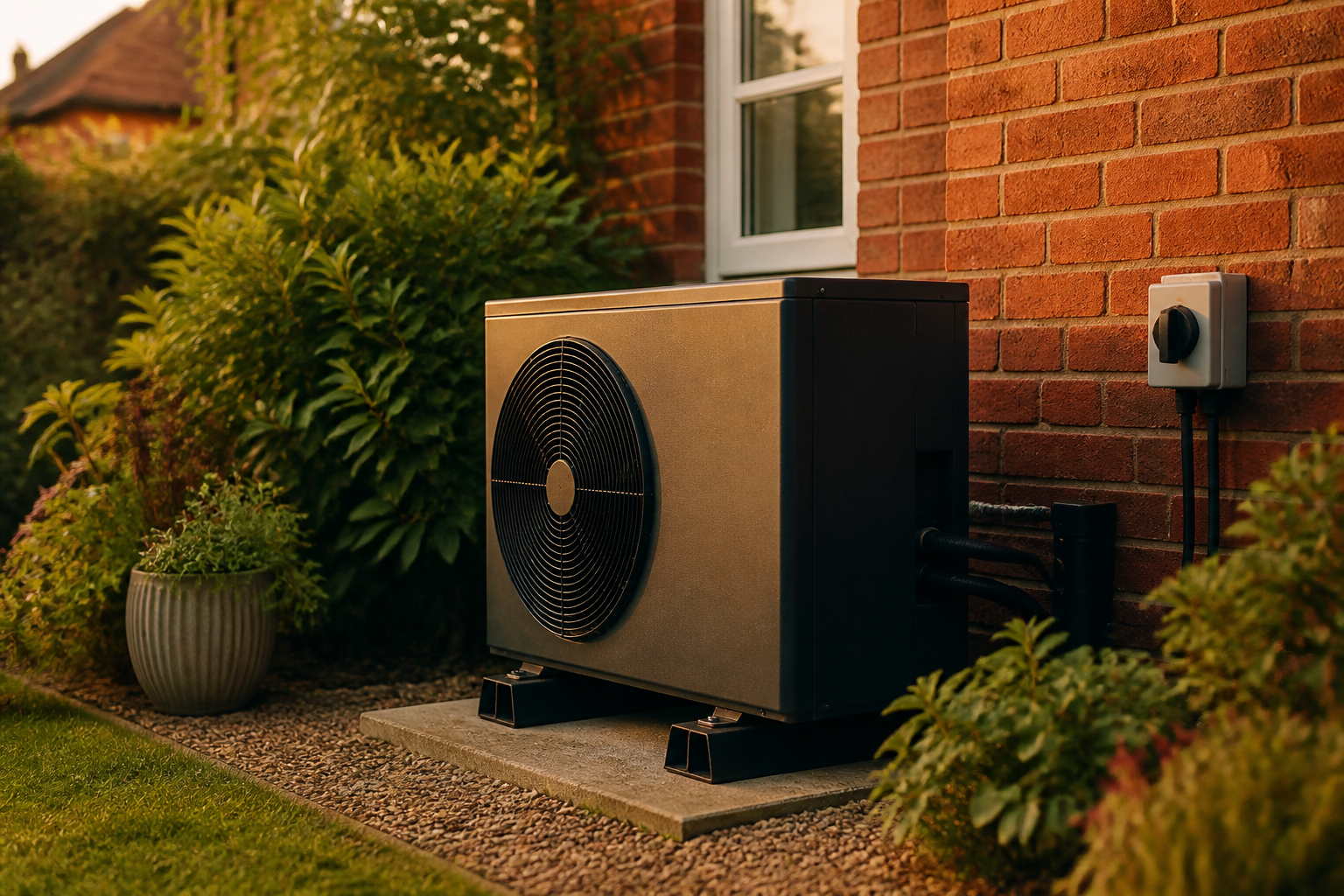
Air-to-air heat pumps, often described as reversible air conditioning systems, offer UK householders an efficient, rapid way to manage room temperatures year-round. Unlike conventional air-to-water heat pumps that heat water for radiators or underfloor loops, an air-to-air system transfers heat directly between outdoor ambient air and indoor room air. In winter, the system extracts heat from outdoor air to warm indoor spaces. In summer, the process reverses to provide active cooling. According to data published by the Energy Saving Trust, modern inverter-driven air-to-air heat pumps achieve Seasonal Coefficient of Performance (SCOP) ratings between 3.5 and 4.8. This means that for every kilowatt-hour (kWh) of electricity consumed, the system yields 3.5 to 4.8 kWh of heat.
Essential checks before booking an installation
Before purchasing hardware or signing an installation contract, householders need to evaluate four practical factors: planning permission, electrical supply, physical location, and room heat loss.
First, check local planning rules. In England, external heat pump units generally fall under Permitted Development Rights as specified in the Town and Country Planning (General Permitted Development) (England) Order 2015. To qualify without a formal planning application, the outdoor compressor unit must be located at least one metre from the property boundary, have a total volume under 0.6 cubic metres, and meet noise limits set out in Microgeneration Certification Scheme (MCS) standard MCS 020, which is typically under 42 decibels at the nearest neighbouring window. In Wales and Scotland, permitted development regulations differ slightly, especially near conservation areas or listed buildings, where written confirmation from the local planning authority is recommended.
Second, assess your home's electrical capacity. A single-room split system requires a dedicated electrical supply rated between 13 and 20 amperes (A), connected to your main consumer unit via a Miniature Circuit Breaker (MCB) and Residual Current Device (RCD) adhering to BS 7671 wiring regulations. If you plan to install a multi-split system serving four or five rooms, the total electrical load may exceed 30A. Your installer should verify that your main service fuse, commonly rated at 60A, 80A, or 100A, can accommodate the added demand alongside existing domestic appliances.
Third, select suitable locations for both external and internal units. The outdoor compressor requires unobstructed airflow and clear access for routine maintenance. Avoid siting outdoor units in narrow side passages where sound can echo between walls. Inside, high-wall mounted units should sit at least 15 centimetres below the ceiling to ensure adequate air circulation through the intake grilles.
Fourth, consider room heat loss. Air-to-air heat pumps deliver rapid, targeted heating, but uninsulated drafty rooms will lose heat quickly once the unit turns off. Ensure loft insulation meets the recommended 270mm depth and wall cavities are insulated where feasible to maximize operational efficiency.
Equipment costs and installation pricing

System costs depend on the number of indoor units, known as heads, connected to the outdoor compressor. Single split systems heat or cool a single zone, whereas multi-split systems handle multiple rooms from one outdoor compressor.
| System Type | Typical Installed Cost | SCOP Rating Range | Installation Time | Ideal Application |
|---|---|---|---|---|
| Single Split (1 Indoor Head) | £1,200 - £2,200 | 4.0 - 4.8 | 1 day | Home office, master bedroom, or loft conversion |
| Multi-Split (2-3 Indoor Heads) | £2,800 - £4,500 | 3.8 - 4.5 | 1 - 2 days | Open-plan living area and upstairs bedrooms |
| Multi-Split (4-5 Indoor Heads) | £4,500 - £7,000 | 3.5 - 4.2 | 2 - 3 days | Whole-floor coverage or multi-story property |
Running costs depend on your electricity tariff. At a representative domestic tariff of 24.5p per kWh, reflecting Ofgem price cap benchmarks, an air-to-air heat pump operating at an SCOP of 4.0 delivers heat at an effective cost of roughly 6.1p per kWh. This compares favourably with direct electric panel heaters at 24.5p per kWh and sits close to standard gas boiler heating costs, with the added benefit of summer cooling capability.
Qualifications and credentials to look for in an installer
Unlike gas installations which require Gas Safe registration, heat pump systems that use chemical refrigerants are regulated under environmental laws.
- F-Gas Certification: By law under the Fluorinated Greenhouse Gases Regulations 2015, any technician installing, servicing, or handling refrigerant in air-to-air heat pumps must hold a valid F-Gas certificate issued by an accredited body such as REFCOM or City & Guilds. Always ask to see the installer's F-Gas registration number before signing a contract.
- Electrical Qualifications: Wiring connections must comply with IET Wiring Regulations (BS 7671). Look for installers registered with a competent person scheme such as NICEIC, NAPIT, or ELECSA, enabling them to self-certify electrical work under Part P of the Building Regulations in England and Wales.
- Consumer Protection: Choose companies affiliated with consumer codes like the Renewable Energy Consumer Code (RECC) or the Home Insulation and Energy Systems Contractors Scheme (HIES), which protect customer deposits and offer independent dispute resolution.
Questions to ask prospective installers:
- Are you F-Gas certified, and can you provide your registration number?
- Will you perform a room-by-room heat loss calculation to size the units correctly?
- Does the quote include electrical consumer unit upgrades and external mounting brackets?
- What maintenance schedule is required to preserve the manufacturer warranty?
- Will you submit the Part P electrical notification to local building control?
The installation timeline from survey to commissioning
A standard installation follows a clear four-stage sequence spread over two to three weeks.
Stage 1: Initial Survey and System Sizing (Week 1) An engineer visits your property to inspect room dimensions, window sizes, wall insulation, and electrical service capacity. They calculate heat losses in kilowatts (kW) to select correctly sized equipment. Oversized units cycle on and off too frequently, reducing efficiency, while undersized units struggle in deep winter.
Stage 2: Quotation and Permissions (Week 2) The installer provides an itemized quote detailing hardware models, wall bracket specifications, electrical requirements, and labor. If the system total electrical draw exceeds 16 amperes per phase, the installer submits a G98 or G99 notification to your local Distribution Network Operator (DNO).
Stage 3: On-Site Installation (Week 3) On installation day, engineers mount the outdoor compressor on rubber anti-vibration pads or heavy-duty wall brackets. They core-drill a 65mm hole through the external wall, line it with protective conduit, and mount the indoor unit. Copper refrigerant pipework, electrical control cabling, and condensate drain lines are routed through the wall penetration.
Stage 4: Evacuation, Testing, and Handover (Week 3) The installer uses a vacuum pump to evacuate moisture and air from the pipework before releasing the refrigerant. Pressure testing confirms there are no leaks. Once running, the technician measures airflow temperatures, demonstrates remote controls or smartphone apps, and leaves a completed commissioning logbook.
What this means for you
Air-to-air heat pumps provide an effective, flexible heating solution for homes where space constraints or radiator retrofits make hydronic air-to-water systems impractical. They excel in specific zones such as home offices, conservatory extensions, or top-floor bedrooms that overheat in summer and chill in winter.
When considering options, evaluate whether you require central hot water heating. Because air-to-air systems only heat indoor air, hot water must still be provided by a separate cylinder, immersion heater, or dedicated heat pump water heater.
For householders exploring clean energy installations across England, Scotland and Wales, the Net Zero Home Scheme offers member pricing on accredited home energy technologies, including heat pumps, solar arrays, and energy storage, without salary sacrifice or complex admin.
Frequently asked questions
Can I get a Boiler Upgrade Scheme grant for an air-to-air heat pump?
No. In England and Wales, the government's Boiler Upgrade Scheme (BUS) only provides capital grants for hydronic systems, such as air-to-water or ground-to-water heat pumps, and biomass boilers that replace fossil fuel systems and supply central hot water and space heating. Air-to-air systems do not qualify for BUS funding, although they benefit from zero-rate VAT on energy-saving materials installed in residential properties across Great Britain until March 2027.
Do air-to-air heat pumps require planning permission in England?
In most cases, no. Under Permitted Development Rights in England, installing an air-to-air heat pump is permitted without full planning permission provided the outdoor unit is under 0.6 cubic metres in size, placed at least one metre from any property boundary, and complies with MCS 020 noise standards. However, if your home is a listed building or situated in a conservation area, you should check with your local planning authority before starting work.
How noisy is the outdoor compressor unit during operation?
Modern outdoor heat pump units operate at sound levels between 40 and 52 decibels (dB(A)) at a distance of one metre, which is comparable to the sound of a quiet refrigerator or rainfall. Inside the house, high-wall units typically produce between 19 and 35 dB(A) depending on fan speed, making low-fan night modes quiet enough for bedrooms.
Sources
- Heat Pump Guide, Energy Saving Trust
- Permitted Development Rights for Householders, Planning Portal
- F-Gas Qualifications for Equipment Engineers, UK Government
- Boiler Upgrade Scheme Guidance, Ofgem