Phase Change Thermal Storage: Physics and Retrofits
An explainer on latent heat physics, space savings, and heat loss economics of phase change heat batteries compared to hot water cylinders in UK homes.
- Written by
- Net Zero Home Scheme editorial team
- Last updated
- Topic
- heat pumps, energy efficiency, energy bills
Replacing a fossil fuel boiler with an electric heat pump or solar thermal system often requires dedicated domestic hot water storage. In many UK homes, particularly flats, compact terraces, and properties converted during the late 20th century, finding space for a standard 200-litre unvented hot water cylinder is a significant structural barrier. Phase change thermal batteries have emerged as an alternative technology that stores thermal energy in chemical phase transitions rather than liquid volume. Understanding the physics, efficiency trade-offs, and economics of phase change storage helps householders evaluate whether the high energy density justifies the higher upfront cost.
The physics of latent heat versus sensible heat
Conventional hot water cylinders store energy as sensible heat. When water is heated from 15°C to 65°C, its temperature rises linearly as kinetic energy accumulates within its molecules. Specific heat capacity determines this exchange: liquid water requires approximately 4.18 kilojoules of energy to raise one kilogram of water by one degree Celsius (4.18 kJ/kg·K). Storing 10 kWh of sensible thermal energy across a 50°C temperature lift requires roughly 172 litres of water, plus cylinder insulation and casing.
Phase change materials (PCMs) utilise latent heat alongside sensible heat. Latent heat is the thermal energy absorbed or released when a substance changes its physical state at a constant temperature, such as transitioning from solid to liquid. Heat batteries designed for domestic hot water typically use inorganic salt hydrates, such as sodium acetate trihydrate. This material undergoes a phase change from solid to liquid at around 58°C.
During charging, input heat from an electric element, heat pump, or solar system melts the salt crystals, locking energy into the liquid chemical bonds without raising the temperature further during the transition. When hot water is drawn, cold mains water passes through an internal heat exchanger inside the battery. The molten salt transfers its stored latent heat back to the incoming water, recrystallising into a solid phase. Because the phase change stores approximately 200 to 250 kilojoules per kilogram at constant temperature, the volumetric energy density of the material is up to four times greater than that of water.
Space savings, dimensions and floor loading
The principal physical advantage of phase change thermal storage is volumetric efficiency. A conventional 200-litre unvented hot water cylinder typically stands 1.5 metres high with a diameter of 550 millimetres, occupying approximately 0.4 square metres of floor footprint and requiring clearance for pipework, expansion vessels, and discharge tundishes.
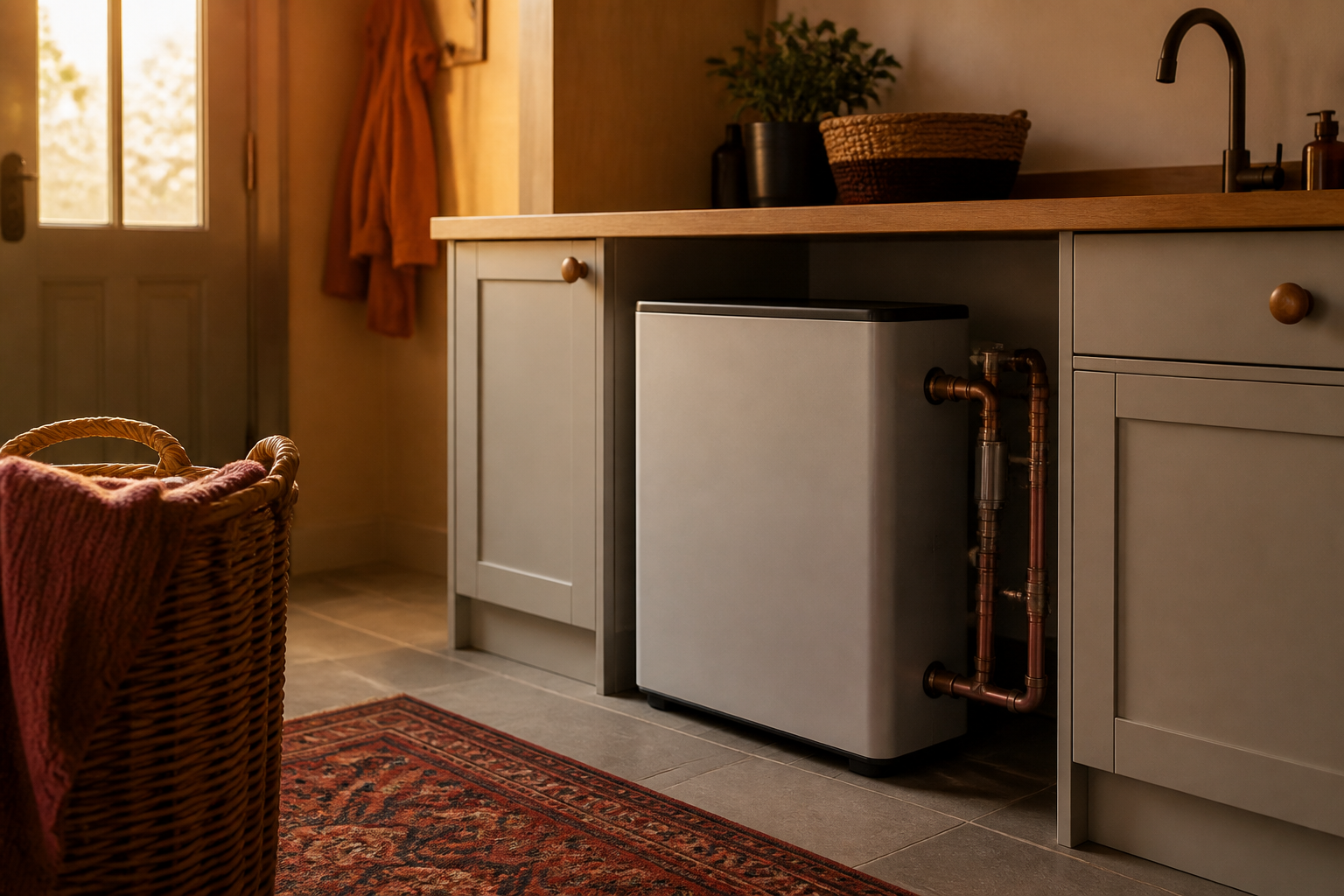
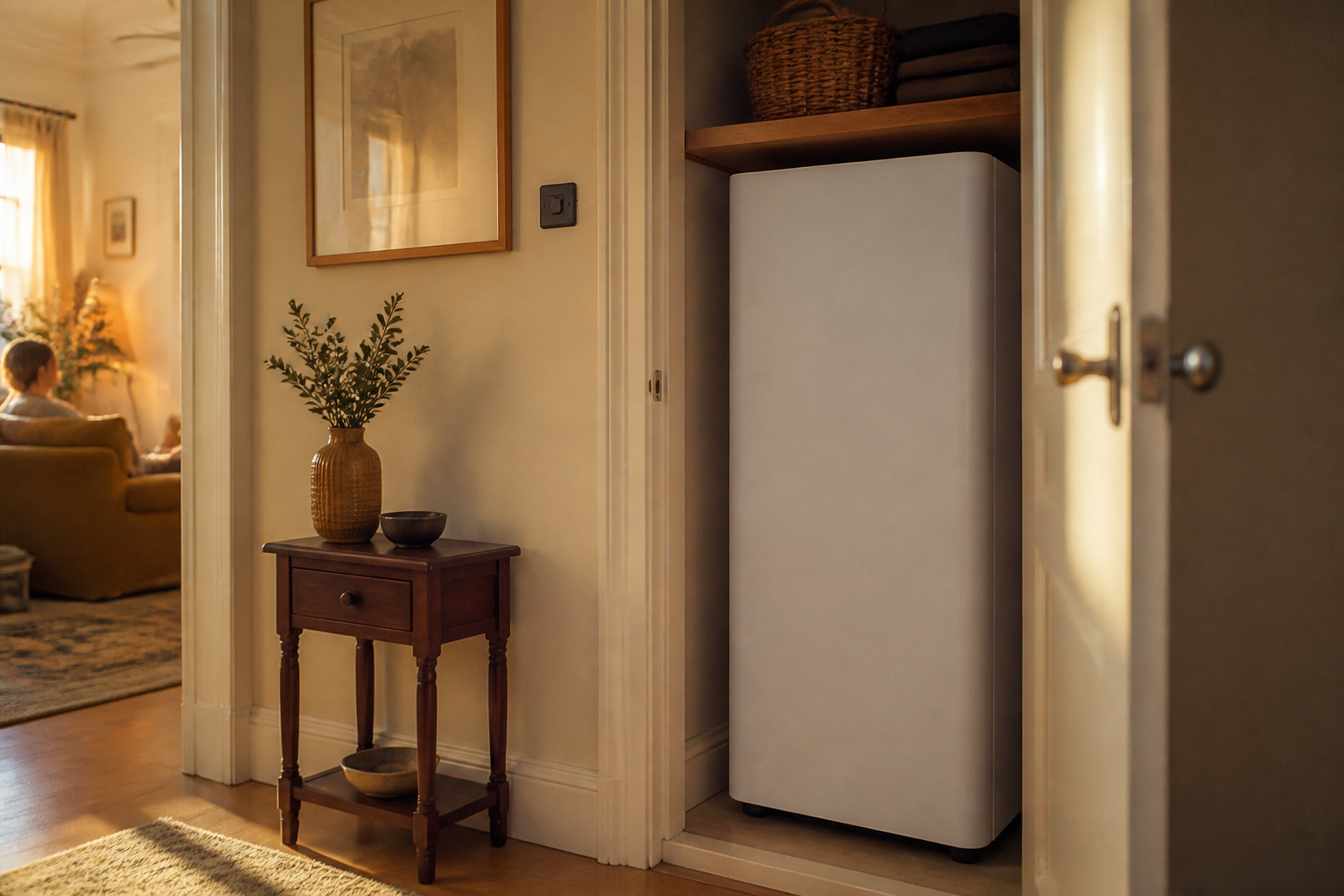
A phase change thermal battery providing equivalent useful hot water output occupies approximately 0.15 to 0.20 cubic metres, often designed to fit beneath standard kitchen worktops or inside shallow cupboards where a traditional cylinder cannot fit.
| Parameter | Standard 200L Water Cylinder | 10 kWh Phase Change Battery |
|---|---|---|
| Volumetric footprint | 0.35 to 0.45 m³ | 0.12 to 0.18 m³ |
| Approximate dimensions | 1500 mm x 550 mm | 580 mm x 570 mm x 840 mm |
| Dry weight | 45 to 60 kg | 130 to 180 kg |
| Operational weight | 245 to 260 kg | 130 to 180 kg |
| 24-hour standing heat loss | 1.2 to 1.8 kWh | 0.4 to 0.7 kWh |
| Maximum discharge rate | Tank capacity limited | Heat exchanger limited (15 to 25 L/min) |
While the physical volume is lower, phase change materials are denser than water. Sodium acetate trihydrate has a density of roughly 1.45 grams per cubic centimetre. Because a thermal battery contains concentrated salt and copper heat exchangers, its mass is concentrated into a smaller footprint. Installers must assess timber joist loading under Building Regulations Part A when placing units on upper timber floors, as the concentrated point load per square metre can exceed standard domestic design limits.
Thermal efficiency, standing losses and heat pump integration
Energy loss in thermal storage occurs primarily through heat dissipation across the casing into the surrounding room, known as standing loss. Standard unvented water cylinders use expanded polyurethane foam insulation, losing between 1.2 kWh and 1.8 kWh per 24 hours under test conditions governed by BS EN 12897.
Phase change heat batteries are encapsulated in vacuum insulation panels (VIP). VIPs achieve thermal conductivities as low as 0.004 W/mK, compared to roughly 0.022 W/mK for polyurethane foam. As a result, 24-hour standing losses for a 10 kWh phase change unit drop to between 0.4 kWh and 0.7 kWh according to manufacturer test data certified under standard laboratory conditions.
However, thermodynamic trade-offs exist when pairing phase change batteries with heat pumps. Air source heat pumps operate most efficiently at flow temperatures between 45°C and 55°C. To melt sodium acetate trihydrate completely and charge a phase change battery to capacity, input flow temperatures of 60°C to 65°C are required. Operating a heat pump at 65°C reduces its seasonal coefficient of performance (SCOP) from around 3.8 down to 2.2 for that specific heating cycle. Consequently, while standing losses are lower, the electricity required to charge the battery using a heat pump is higher than heating a water cylinder to 50°C.
Capital costs, lifespan and economic trade-offs
The financial viability of phase change storage depends heavily on space constraints and electricity tariffs. Based on established industry pricing, a standard 200-litre stainless steel cylinder installed costs between £1,500 and £2,500 including pipework and expansion safety controls. An equivalent 7 to 10 kWh phase change battery costs between £3,500 and £5,500 installed.
Counter-arguments against phase change batteries center on this capital cost premium and discharge dynamics:
- Heat exchanger flow rates: Domestic hot water delivery relies on instant heat transfer through internal exchangers. If high peak delivery is demanded simultaneously across multiple bathrooms, water temperature can drop faster than in an unvented cylinder with stored hot water.
- Component repairability: A stainless steel vessel contains simple mechanical valves. Phase change batteries contain sealed salt cores, electronic controls, and embedded heat exchangers; core degradation or internal leaks generally require replacing the modular unit rather than servicing individual plumbing components.
- Phase separation risk: Repeated freeze-thaw thermal cycles over 10 to 15 years can cause incongruent melting in some salt hydrates, where solid components settle to the bottom and reduce effective storage capacity over time, though modern formulations add thickening agents to mitigate this.
Where phase change batteries excel economically is in properties taking advantage of dynamic time-of-use energy tariffs without space for a water cylinder. Charging the unit during cheap off-peak hours supplies hot water throughout the day, saving money compared to direct electric immersion heating.
What this means for you
If you live in a property with ample space, an unvented hot water cylinder remains the most cost-effective and thermodynamically efficient pairing for heat pumps and solar PV systems. However, if space is strictly limited, phase change thermal storage offers a viable solution under specific installation conditions:
- Assess space constraints: Measure potential locations, including under-counter spaces, to determine if a conventional cylinder is structurally impossible.
- Check floor loading: Ensure timber joists or floor structures can support point loads between 150 kg and 200 kg over a footprint under 0.35 square metres.
- Review hot water demand: Verify that peak discharge flow rates meet your household simultaneous usage needs.
- Confirm installation standards: Ensure the unit complies with Building Regulations Part G and Part L, and that work is carried out by an accredited installer holding TrustMark or MCS certification where relevant.
Employees looking to install low-carbon technology can access discounted pricing through the Net Zero Home Scheme, which connects homeowners with accredited installers for heat pumps, solar PV, and battery systems without salary sacrifice.
Frequently asked questions
How long do phase change thermal batteries last?
Manufacturers engineer salt hydrate phase change batteries for 10,000 to 15,000 thermal cycles, which equates to an operational lifespan of 15 to 20 years under normal domestic hot water usage patterns, comparable to high-grade stainless steel cylinders.
Can a phase change battery be charged using solar PV surplus?
Yes. Phase change thermal batteries include direct electric heating elements or integrated controllers that modulate input power to absorb excess solar PV generation, converting variable generation into stored latent heat for hot water.
Do phase change heat batteries require annual servicing?
Unlike unvented hot water cylinders, which require annual checks on pressure relief valves, expansion vessels, and strainers under Building Regulations Part G, phase change batteries have fewer external pressure vessels, requiring minimal mechanical servicing, though electrical connection checks remain best practice.
Sources
- Storing Energy in the Home, Energy Saving Trust
- MCS Standards and Guidance, Microgeneration Certification Scheme (MCS)
- Standard Assessment Procedure (SAP), Building Research Establishment (BRE)