Upgrading Your Electrical Supply for Home Renewables
Upgrading your electricity main fuse and consumer unit ensures your UK home safely handles heat pumps, solar panels, and EV chargers.
- Written by
- Net Zero Home Scheme editorial team
- Last updated
- Topic
- electrical supply, heat pumps, solar pv
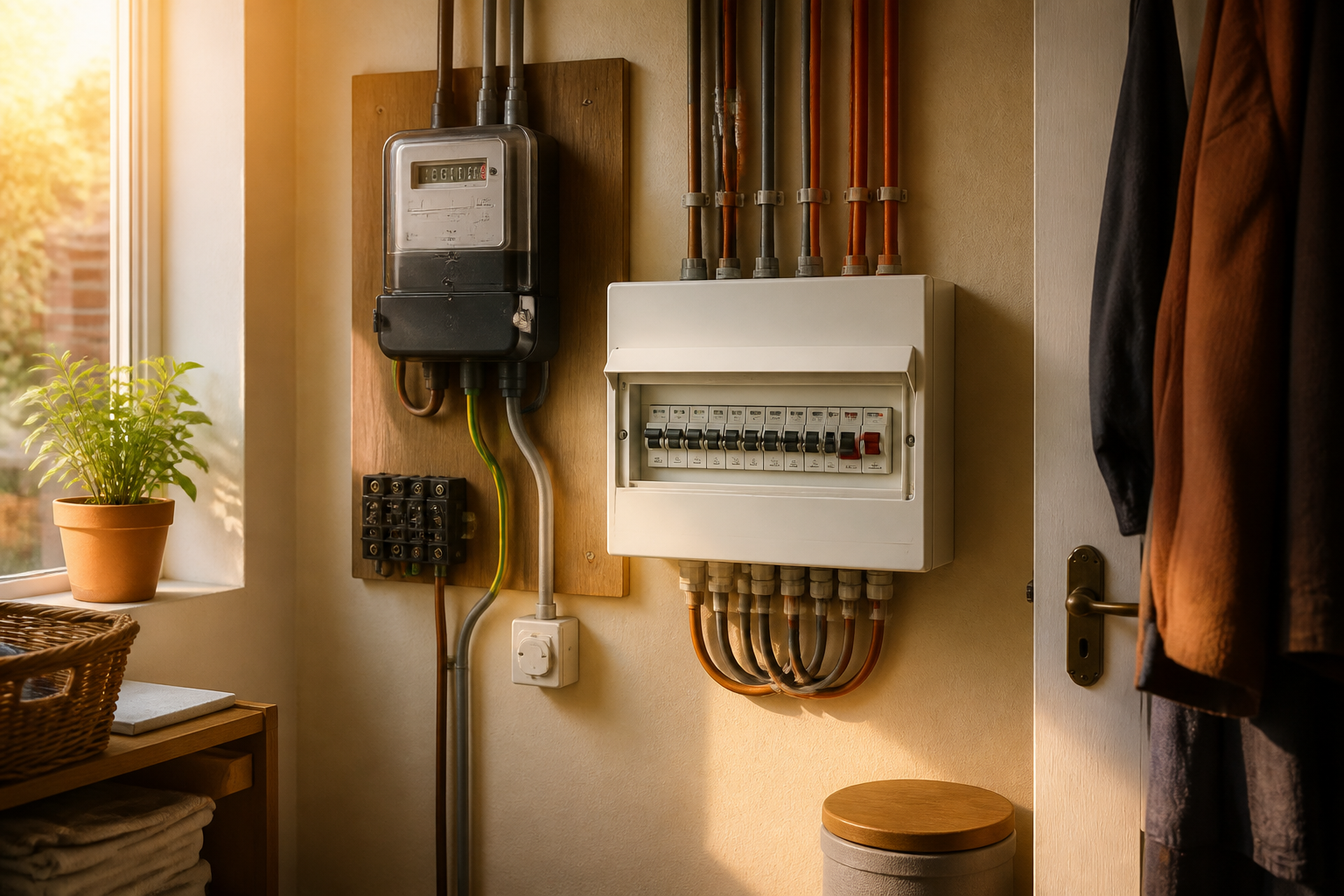
Upgrading your home's electrical supply is often the essential first step before installing low-carbon technologies such as heat pumps, solar panels, battery storage, or electric vehicle chargers. Many residential properties across England, Scotland, and Wales were built when household electrical demand was limited to basic lighting, refrigeration, and small appliances. Connecting modern high-draw appliances to an outdated electrical system can lead to blown main fuses, voltage fluctuations, or project delays if your Distribution Network Operator (DNO) halts installation pending infrastructure work.
Assessing your current electrical setup before ordering equipment ensures that your home can safely support higher peak loads. Understanding fuse ratings, supply configurations, consumer units, and earthing arrangements allows you to plan upgrades efficiently and avoid unexpected costs during installation.
How to assess your current electrical infrastructure
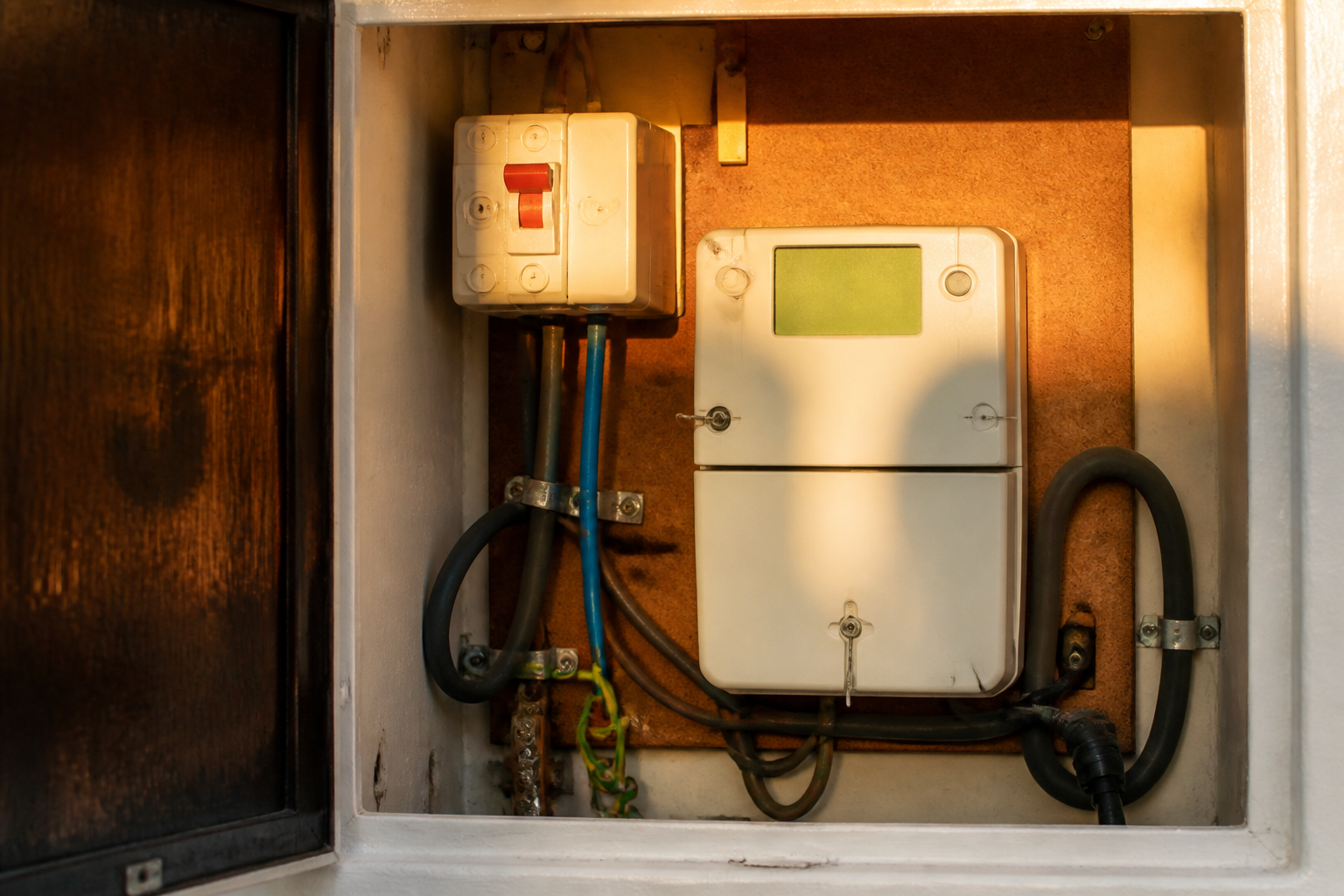
Before purchasing renewable energy equipment or ordering an EV charger, inspect your primary electrical intake area, usually located near your electricity meter in a hallway, garage, or outdoor meter box.
Key components to check include:
- Main cutout fuse rating: The main fuse sits in a sealed brown, black, or grey casing directly before your electricity meter. Older UK properties frequently have 60 Amp (60A) cutouts, providing maximum peak power of roughly 13.8 kW. Modern electrified homes typically require an 80A (18.4 kW) or 100A (23.0 kW) cutout fuse.
- Looped service cables: In many terraced and semi-detached homes built between 1930 and 1980, electricity service cables were looped from one property to the next. If your supply is looped, your main supply cable feeds your neighbor's cutout fuse as well. DNOs strictly regulate additional loads on looped supplies to prevent voltage drop and overload.
- Consumer unit condition: Your fuse box or consumer unit distributes electricity throughout your home. Systems installed prior to 2018 may lack Residual Current Devices (RCDs), Residual Current Breakers with Overcurrent protection (RCBOs), or Surge Protection Devices (SPDs) required under current IET Wiring Regulations (BS 7671).
- Earthing arrangement: UK properties generally use Protective Multiple Earthing (TN-C-S / PME), separate earth conductors (TN-S), or earth rods (TT). The type of earthing dictates whether an installer must add localized earth rods for outdoor chargers or solar equipment to protect against neutral fault conditions.
What an electrical supply upgrade costs in the UK
The cost of upgrading your electrical infrastructure depends on whether work is required on the network operator's side of the meter or within your home wiring.
- Main fuse upgrade: Upgrading a 60A cutout fuse to 80A or 100A is performed by your DNO. According to published service standard guidelines from Ofgem, network operators generally perform main fuse upgrades free of charge, provided the existing incoming service cable has adequate current-carrying capacity.
- Cable unlooping: If your home has a looped service cable, the DNO must unloop the cable by laying a new dedicated service line from the street main to your property. Energy Networks Association guidance confirms that network operators fund unlooping works in the vast majority of domestic cases because unlooping improves overall network safety and capacity.
- Consumer unit replacement: Upgrading an old fuse box to a modern, metal-clad consumer unit fitted with individual RCBOs and type 2 surge protection typically costs between £600 and £1,500. This price includes labour, safety testing, and official notification to local authority Building Control.
- Three-phase supply conversion: Upgrading from single-phase to three-phase supply increases total available power up to 69 kW (100A per phase). Three-phase power is rarely required for standard homes, but may be necessary for large properties operating multiple 22 kW EV chargers or multi-compressor heat pumps. DNO quotes for three-phase upgrades typically range from £1,500 to £4,500 depending on street excavation distance.
Step-by-step upgrade process and realistic timelines
Upgrading your supply requires coordination between your registered electrician, your Distribution Network Operator, and your equipment installers.
| Supply Type | Typical Capacity | Common Home Uses | Upgrade Requirement |
|---|---|---|---|
| Single-Phase (60A) | 13.8 kW peak | Standard home without heat pump or EV | Upgrade to 80A/100A recommended for renewables |
| Single-Phase (80A) | 18.4 kW peak | Home with solar PV and small EV charger | Sufficient for most moderate electrification plans |
| Single-Phase (100A) | 23.0 kW peak | Home with heat pump, solar, battery, and EV | Ideal standard for fully electrified properties |
| Three-Phase (100A per phase) | 69.0 kW peak | Large properties with multiple chargers | Requires street excavation and service modification |
The standard process follows five predictable stages:
- Step 1: Electrical inspection. A registered electrician inspects your consumer unit, earthing, and service head, recording fuse ratings and taking photographs of the setup (1 to 2 weeks).
- Step 2: DNO application. If a fuse upgrade or unlooping is required, your electrician or installer submits an application to your local DNO, such as National Grid Electricity Distribution or UK Power Networks (2 to 4 weeks for review).
- Step 3: DNO site works. The DNO schedules works to upgrade the main fuse or excavate the footpath to unloop service cables. Simple fuse swaps take under an hour, whereas unlooping projects take 4 to 12 weeks from application to completion.
- Step 4: Internal electrical updates. Your electrician installs a modern consumer unit, fits dedicated supply tails, and mounts isolation switches for new renewable equipment (1 day).
- Step 5: Certification and notification. The electrician carries out full dead and live testing, issuing an Electrical Installation Certificate (EIC) and registering the work with Building Control within 30 days.
What to ask your electrician and network operator
Before signing quotes or scheduling works, ask your chosen electrician and network provider these practical questions:
- Has my property been identified as having a looped supply, and will the DNO need to carry out street excavation before high-draw equipment is installed?
- Does my current earthing arrangement require an additional earth rod or specialized protective device for outdoor charging points?
- Will the proposed consumer unit upgrade include spare switch ways and individual RCBO protection for future additions like solar inverters or battery storage?
- Will you provide a full Electrical Installation Certificate and register the work under a recognised competent person scheme upon completion?
Required accreditations and installation standards
All domestic electrical modifications must comply with strict national safety standards. When selecting an electrician or installer, confirm that they hold relevant professional certifications.
- Competent person schemes: Ensure your electrician is registered with a recognized scheme such as the National Inspection Council for Electrical Installation Contracting (NICEIC), the National Association of Professional Inspectors and Testers (NAPIT), or the Electrical Contractors' Association (ECA).
- Wiring regulations: All work must comply fully with BS 7671:2018+A2:2022 (the IET Wiring Regulations 18th Edition), ensuring appropriate cable sizing, overcurrent protection, and surge protection.
- Quality assurance: Installers operating under consumer protection frameworks like TrustMark provide independent dispute resolution and insurance-backed guarantees.
- Grid notification: Installers connecting solar PV or battery storage must follow Energy Networks Association (ENA) notification processes under Engineering Recommendation G98 (for small generation up to 16A per phase) or obtain prior approval under Engineering Recommendation G99 for larger systems.
What this means for you
Preparing your domestic electrical infrastructure creates a reliable, safe foundation for all future clean energy technology. Identifying cutout fuse limits early prevents sudden supply trips, avoids project delays during equipment installation, and ensures full compliance with UK safety regulations.
When evaluating home energy upgrades, programs like the Net Zero Home Scheme assist UK employees with member pricing on solar, battery storage, and heat pumps fitted by accredited installers across England, Scotland, and Wales.
Frequently asked questions
How do I find out who my Distribution Network Operator (DNO) is?
Your Distribution Network Operator manages the underground cables and substations in your area. You can identify your DNO by entering your postcode into the Energy Networks Association online lookup tool, which links your property to one of the regional operators across Great Britain.
Is unlooping a shared electricity supply free of charge?
Under standard network guidelines across Great Britain, DNOs generally unloop shared domestic electricity service cables at no direct charge to the property owner. Network operators prioritize unlooping because shared lines restrict local grid management and can cause voltage instability when high-power devices are connected.
Do I need a three-phase electrical supply for a standard heat pump and EV charger?
Most single-family UK homes do not require a three-phase supply. A single-phase 100A electrical supply provides up to 23 kW of peak capacity, which is sufficient to operate a standard domestic air source heat pump, a 7 kW smart EV charger, and household appliances simultaneously when combined with smart energy management.
Sources
- Energy Networks Association: Connecting Generation and High-Power Devices, Energy Networks Association
- Ofgem: Electricity Distribution Networks and Service Standards, Ofgem
- Institution of Engineering and Technology: Wiring Regulations (BS 7671), Institution of Engineering and Technology
- Electrical Safety First: Consumer Units and Regulations, Electrical Safety First