Installing an EV Home Charger: A Practical UK Guide
A practical guide to installing a dedicated 7kW smart EV home charger, covering main fuse checks, DNO approvals, installation costs, regulations, and realistic timelines.
- Written by
- Net Zero Home Scheme editorial team
- Last updated
- Topic
- ev charging, home energy, electrical installation

Installing a dedicated home electric vehicle charger is one of the most practical upgrades a driver can make. While a standard three-pin household socket can charge a car, it is slow and not designed for continuous high-power loads over many hours. A dedicated 7kW wallbox charges up to three times faster, incorporates vital safety features, and opens up access to smart off-peak electricity tariffs.
Getting a home charger fitted requires navigating electrical capacity checks, grid notifications, smart regulations, and installer selection. This guide sets out the practical steps, realistic costs, and essential questions to ensure a smooth installation.
Assessing your home electrical setup
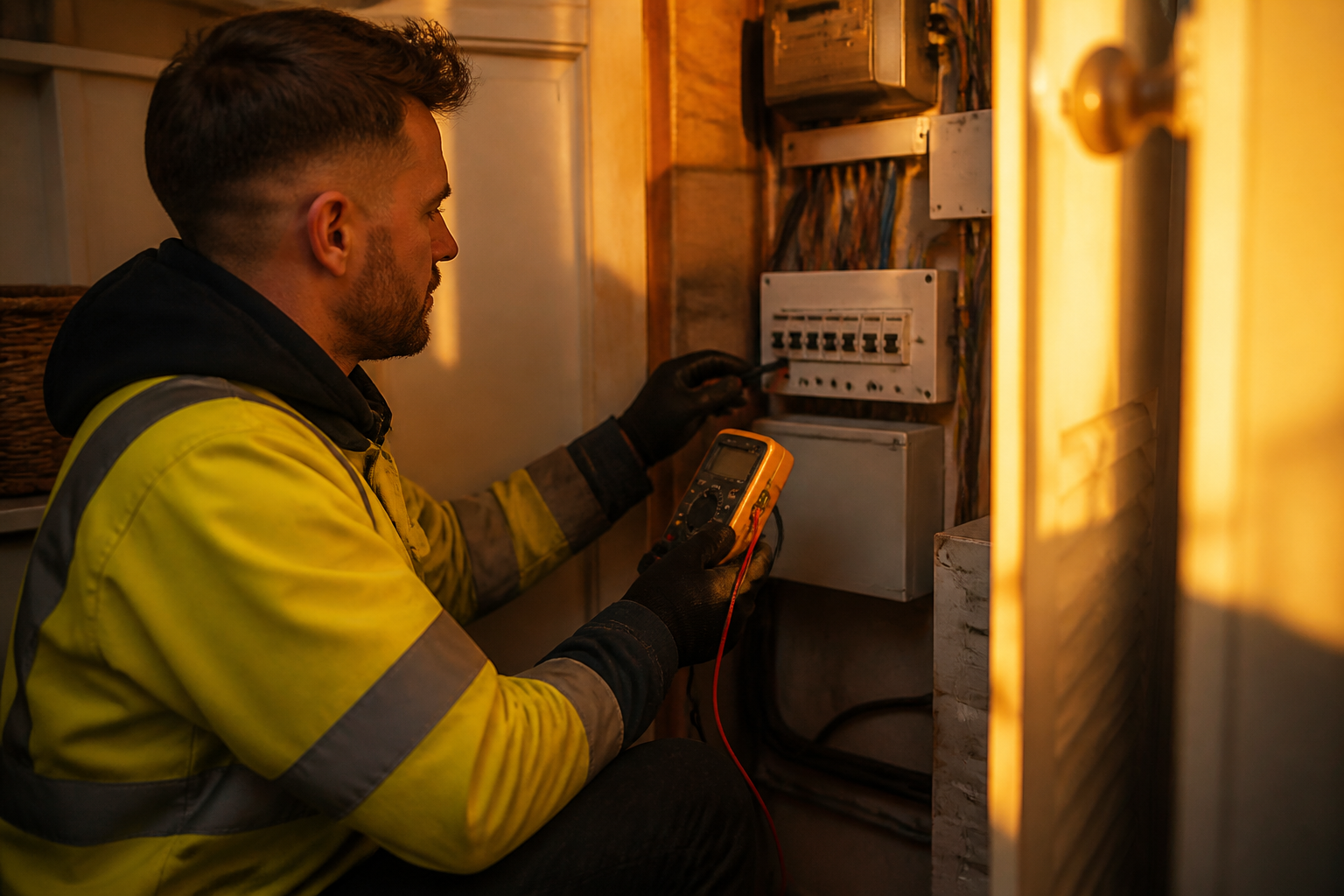
Before selecting a charger hardware model, you must verify that your home electrical system can handle the additional load. A standard single-phase 7kW home charger draws 32 amps continuously. For context, this represents a significant portion of a typical property's total electrical capacity.
First, check your main service fuse, located inside or next to your electricity meter box. UK residential main fuses are typically rated at 60, 80, or 100 amps. If your house has a 60-amp main fuse, running a 32-amp charger alongside an electric shower, oven, and heat pump could exceed the threshold. Your installer will check this cut-out rating and, if necessary, request an upgrade from your Distribution Network Operator (DNO).
Second, check whether your property has a looped supply. A looped supply occurs when a single service cable from the street grid feeds two or more adjoining properties, common in semi-detached and terraced houses built in the mid-to-late twentieth century. Under guidelines published by the Energy Networks Association, an installer must identify looped cables prior to work. If a looped supply exists, your local DNO must unloop the cable or give explicit permission before a high-power device can be commissioned.
Third, review your earthing arrangement. Most UK homes use a TN-C-S earthing system (also known as Protective Multiple Earthing). Under section 722 of the IET Wiring Regulations (BS 7671), installing an outdoor charge point on a TN-C-S system requires specific protection against the open PEN conductor risk. Modern chargers satisfy this requirement either by integrating electronic PEN fault detection directly into the unit or by installing an external earth rod into the ground.
Understanding smart charger specifications and regulations
All private charge points sold and installed in Great Britain must comply with the Electric Vehicles (Smart Charge Points) Regulations enforcement framework overseen by the Office for Product Safety and Standards. These regulations mandate specific functionality:
- Default off-peak charging schedules pre-programmed outside peak electricity demand windows (typically 11am to 4pm and 8pm to 10pm).
- Randomised delay functionality of up to 10 minutes at the start and end of a charging cycle to prevent localized grid surges.
- Smart functionality capable of measuring energy consumption and responding to signals from demand-side response service providers.
- Cyber security protections, including encrypted data transmission and software update capabilities.
When choosing hardware, you will decide between a tethered or untethered design. A tethered charger features a permanently connected cable (usually 5 to 8 metres long) with a Type 2 connector. It offers daily convenience because you do not need to retrieve a cable from your boot. An untethered unit features a universal Type 2 socket, providing a cleaner aesthetic on your wall and allowing you to plug in either Type 1 or Type 2 cables.
If your household load is close to your electrical limit, select a charger that supports dynamic load management using a current transformer clamp fitted around your main supply tail. This clamp measures real-time house power draw and automatically throttles the charger down if overall household consumption spikes, preventing your main fuse from blowing.
Expected costs and installation timescales
According to figures published by the Energy Saving Trust, a standard 7kW smart home charger installation typically costs between £800 and £1,200 in total. This total splits into roughly £400 to £700 for the wallbox unit itself, and £300 to £500 for standard installation labour and materials.
A standard installation assumes the charger is mounted on a brick or block wall, a cable run under 10 metres from the consumer unit, no trenching under ground, and sufficient spare capacity inside your consumer unit for a dedicated circuit breaker. Non-standard work, such as lifting driveway paving, drilling through multiple internal walls, or upgrading an old consumer unit, will incur additional costs.
| Installation Phase | Key Actions Required | Typical Duration |
|---|---|---|
| Initial Assessment | Check main fuse rating, consumer unit spare capacity, and earth bonding | 1 to 3 days |
| DNO Application | Submit notification or approval request via Energy Networks Association process | 1 to 10 days (up to 8 weeks if unlooping) |
| Physical Install | Mount wallbox, run dedicated cable, fit CT clamp, test earthing | 3 to 5 hours |
| Commissioning | Connect to Wi-Fi, test PEN fault protection, set smart schedules | 1 hour |
| Post-Install | Installer submits DNO notification and hands over BS 7671 certificate | Within 28 days |
Key accreditations and questions to ask your installer
Electrical work involving a dedicated high-power circuit must be carried out by a competent person under Part P of the Building Regulations in England and Wales, or relevant Scottish Building Standards. When selecting an installation company, verify the following credentials:
- Accreditation with a recognised competent person scheme such as NICEIC, NAPIT, or SELECT.
- Specific training qualifications, such as City & Guilds 2919 (Electric Vehicle Charging Equipment Installation).
- Registration under TrustMark, the government-endorsed quality scheme for home improvements.
Before signing a contract or paying a deposit, ask your installer these practical questions:
- Is my current main service fuse rated adequately, or will a DNO upgrade request be required before work begins?
- Does the quoted price include a dynamic load management CT clamp and an internal PEN fault protection device?
- Will the charge cable run through internal living spaces or around exterior walls, and how will it be clipped or hidden?
- How does the wallbox handle Wi-Fi connectivity if my driveway has weak signal coverage from my home router?
What this means for you
Installing a home charger moves your vehicle refueling from public rapid hubs to your own driveway, lowering your per-mile running costs significantly when paired with an off-peak smart energy tariff. By conducting basic checks on your main fuse, ensuring your installer handles the required DNO notifications, and choosing compliant hardware, you secure a safe and future-proof installation.
If your employer participates in the Net Zero Home Scheme, you can access pre-vetted, accredited installers alongside member pricing on home energy upgrades and smart tariffs.
Frequently asked questions
Can I install a 22kW charger at home?
Most UK residential properties have a single-phase electrical supply, which limits maximum AC charging to 7.4kW at 32 amps. A 22kW charger requires a three-phase electrical supply (400V). While three-phase power is standard in commercial settings, it is rare in UK domestic homes. Upgrading a single-phase residential property to three-phase requires substantial grid work from your Distribution Network Operator, which typically costs thousands of pounds and is unnecessary for daily home overnight charging.
What happens if my home has a looped supply?
If your installer discovers a looped supply during the pre-installation survey, they must submit an application to your local Distribution Network Operator before fitting a 7kW charger. The DNO will inspect the service cable and schedule an unlooping project to provide your house with an independent service pipe. In most cases, DNOs perform standard unlooping work at no direct cost to the householder, although it can extend your project timeline by four to eight weeks.
Do I need planning permission for a home wallbox?
In most cases in England, Wales, and Scotland, installing a wall-mounted EV charger falls under Permitted Development rights, meaning full planning permission is not required. However, specific conditions apply: the charger casing must not exceed 0.2 cubic metres in volume, it must not be mounted higher than 1.6 metres from the ground if facing a highway, and it must not be within the curtilage of a Listed Building or designated scheduled monument. If you live in a leasehold property or flat, you will still need written consent from the freeholder or landlord.
Sources
- Electric Vehicle Charging Equipment Installation Guidance, Energy Saving Trust
- Electric Vehicle Smart Charge Points Regulations 2021, Office for Product Safety and Standards
- Connecting Electric Vehicles to the Electricity Grid, Energy Networks Association