Vehicle-to-Home Power Physics, Economics and Trade-offs
How bi-directional EV charging turns electric vehicles into home batteries, including efficiency losses, battery degradation physics and grid requirements.
- Written by
- Net Zero Home Scheme editorial team
- Last updated
- Topic
- ev charging, battery storage, energy efficiency
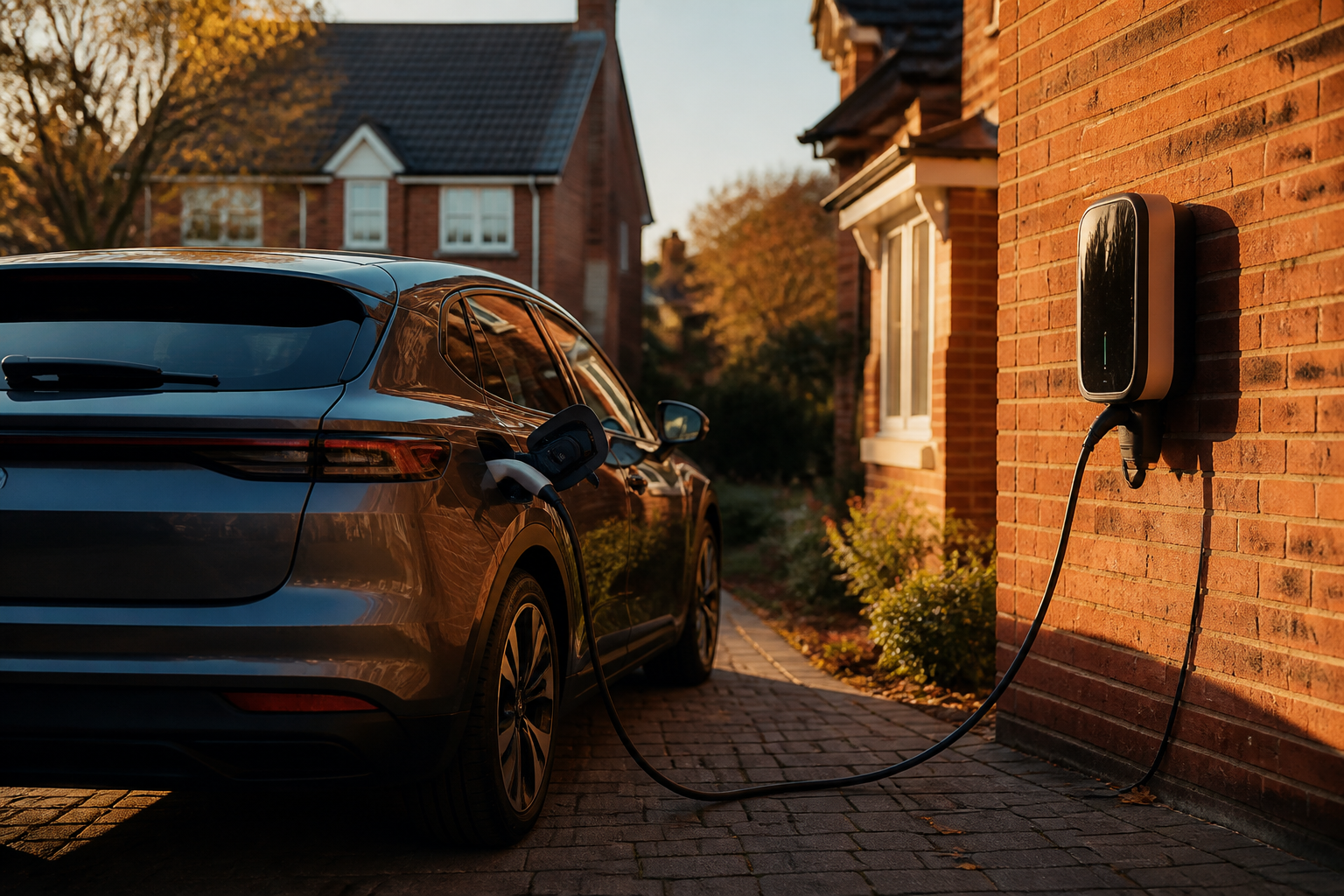
Bi-directional charging allows an electric vehicle to act as more than just a consumer of grid electricity. By enabling power to flow both into and out of the vehicle battery, a car can power a household during peak energy hours or export power back to the national electricity grid. While a typical stationary home battery stores between 5 kWh and 15 kWh of energy, an average electric vehicle battery holds between 50 kWh and 80 kWh. This vast difference in capacity makes vehicle-to-home (V2H) and vehicle-to-grid (V2G) technology an attractive proposition for households seeking to lower energy costs and maximize renewable self-consumption.
However, transforming a car into a domestic energy storage unit involves complex physical processes, power conversion losses, and specific hardware requirements. Understanding the physics, economics, and regulatory framework is essential before deciding whether bi-directional charging is suitable for your home.
The Physics of Bi-Directional Energy Conversion
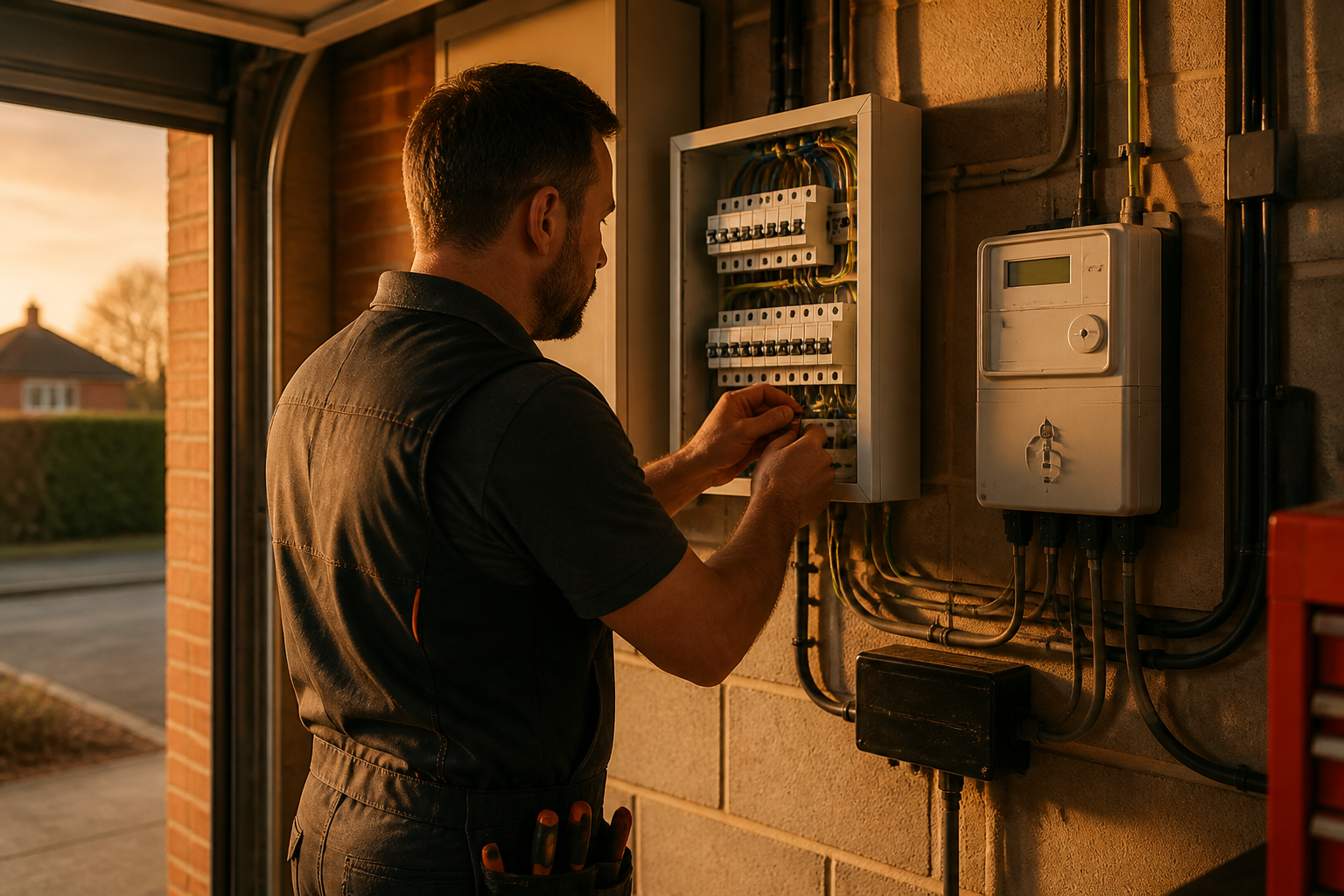
Electric vehicle batteries store energy as direct current (DC). Domestic appliances and the UK electricity grid operate on alternating current (AC). Charging a standard EV requires converting AC power from your domestic supply into DC power within the vehicle onboard charger or via an external DC fast charger.
When reversing this process for V2H or V2G operation, DC electricity stored in the battery must be inverted back into AC electricity synchronized with your home electrical supply at 230 V and 50 Hz. This process can be handled in two distinct system architectures:
- AC Bi-Directional Systems: The vehicle onboard charger contains bi-directional inverter circuitry. The wallbox acts primarily as a communication controller and safety isolation switch, delivering AC directly to the home consumer unit.
- DC Bi-Directional Systems: The vehicle bypasses its internal onboard charger and outputs high-voltage DC directly through a CCS or CHAdeMO socket. An external wall-mounted inverter converts this DC electricity into AC for domestic consumption.
Every conversion step introduces energy losses through electrical resistance and thermal dissipation. Standard uni-directional AC home charging achieves roughly 88% to 92% efficiency. Bi-directional operations incur efficiency losses during both the charge and discharge phases. According to technical testing published by the Energy Saving Trust and independent engineering trials, the overall round-trip efficiency (RTE) for V2H systems typically ranges between 75% and 85%.
Auxiliary power draw also impacts net efficiency. During V2H discharge, the vehicle battery management system (BMS), thermal management pumps, and external inverter control boards consume continuous power, often between 50 W and 200 W. At low domestic power draws, such as overnight baseloads of 200 W, these fixed overheads significantly reduce effective conversion efficiency.
Battery Degradation and Cell Chemistry
A primary concern for vehicle owners is whether bi-directional discharging accelerates traction battery degradation. Battery degradation occurs through two distinct mechanisms: calendar ageing and cyclic ageing.
Calendar ageing happens over time regardless of usage, driven by ambient temperature and state of charge (SoC). Maintaining a lithium-ion battery at high SoC (above 80%) or elevated temperatures accelerates electrolyte breakdown and solid electrolyte interphase (SEI) layer growth.
Cyclic ageing results from the mechanical expansion and contraction of electrode materials during charge and discharge cycles. The impact of V2H operation on cyclic degradation depends heavily on cell chemistry:
- Lithium Iron Phosphate (LFP): LFP batteries exhibit high cycle life, often exceeding 3,000 to 5,000 full equivalent cycles before capacity drops to 80%. Using an LFP-equipped vehicle for daily 5 kWh to 10 kWh home power buffering adds minimal relative degradation over a ten-year period.
- Nickel Manganese Cobalt (NMC): NMC chemistries offer higher energy density but lower cycle life, typically between 1,000 and 2,000 full cycles. Subjecting an NMC pack to daily discharge cycles for domestic use measurably accelerates capacity loss compared to driving alone.
Research from the University of Warwick Centre for Energy Storage indicates that partial depth-of-discharge (DoD) cycling within a middle SoC window (between 30% and 70%) causes substantially less degradation per throughput kWh than full deep cycles. Smart V2H control systems utilize these parameters to minimize battery wear.
Regulatory Standards and Grid Compliance in Great Britain
To connect a bi-directional charger to the British distribution network, installations must comply with strict engineering standards set by the Energy Networks Association (ENA).
Because a V2H or V2G inverter can feed power into the local grid, the installation is governed by Engineering Recommendation G99 for generation equipment. Even if configured for zero export to the external grid, distribution network operators (DNOs) treat bi-directional units as generation assets due to their potential export capability.
The communication protocol between the charger and the vehicle is standardized under ISO 15118-20. This standard defines the digital handshake, security encryption, and physical signal requirements for bi-directional AC and DC power transfer over CCS Type 2 connectors.
System Comparison: Home Storage Options
Evaluating bi-directional vehicle charging requires comparing it against conventional stationary battery storage and standard uni-directional charging setups.
| Parameter | Stationary Home Battery | Vehicle-to-Home (V2H) | Standard EV Charger |
|---|---|---|---|
| Typical Capacity | 5 kWh to 15 kWh | 50 kWh to 80 kWh | N/A (Grid supply only) |
| Round-Trip Efficiency | 85% to 92% | 75% to 85% | N/A |
| Hardware Cost Range | £3,000 to £7,000 | £4,000 to £8,000 | £800 to £1,200 |
| DNO Approval Required | G98 or G99 | G99 Notification / Approval | G74 / G100 (Load managed) |
| Availability | 24 hours a day | Only when parked at home | Only when parked at home |
| Battery Chemistry | Predominantly LFP | LFP or NMC | Vehicle dependant |
Economic Analysis and Genuine Trade-Offs
The financial rationale for V2H relies on dynamic time-of-use tariffs. By charging the vehicle battery during low-cost overnight periods (for example, off-peak rates below 10p per kWh) and discharging to power the home during peak tariff windows (often exceeding 30p per kWh), households can eliminate peak grid electricity purchases.
According to figures from the Energy Saving Trust, a household consuming 10 kWh during peak evening hours could save between £400 and £700 annually through automated load shifting. However, several critical trade-offs must be evaluated:
- Vehicle Absence During Peak Hours: If the vehicle is used for evening commutes or parked away from home during peak tariff periods, the system cannot supply domestic power when financial returns are highest.
- Capital Cost Premium: Bi-directional DC wallboxes currently carry high hardware costs compared to standard smart chargers. The extended payback period can exceed seven to ten years depending on annual throughput.
- Manufacturer Warranties: Not all EV manufacturers permit V2H or V2G operation under standard vehicle warranties. Operating bi-directional discharge on non-approved models may void traction battery coverage.
What this means for you
If you are considering vehicle-to-home technology, take these practical steps to assess suitability:
- Check your vehicle compatibility to confirm whether your EV supports bi-directional power flow under ISO 15118-20 or CHAdeMO protocols.
- Review your vehicle warranty documentation regarding stationary discharge limits and approved wallbox hardware.
- Evaluate your home parking patterns to ensure the vehicle is parked and connected during peak domestic electricity usage hours (typically 16:00 to 20:00).
- Consult a certified electrical installer registered with TrustMark and the Renewable Energy Consumer Code (RECC) to submit a G99 application to your Distribution Network Operator before purchasing equipment.
Employees looking to adopt clean technology can access member pricing on heat pumps, solar PV, and battery systems through the Net Zero Home Scheme, which is delivered free for employers without salary sacrifice.
Frequently asked questions
Will using V2H void my electric vehicle battery warranty?
It depends on the manufacturer. Some vehicle manufacturers explicitly endorse V2H or V2G use and include energy throughput thresholds within their warranty terms, whereas others restrict battery warranties strictly to road driving and standard charging. Always verify written warranty terms prior to installing a bi-directional charger.
Do I need G99 approval from my Distribution Network Operator for V2H?
Yes. Because bi-directional chargers contain inversion equipment capable of feeding electricity into the local network, DNOs classify them as generation units. An application under ENA Engineering Recommendation G99 must be submitted and approved by your DNO prior to commissioning.
Can V2H keep my house powered during a power cut?
Only if the system includes islanding protection and an automated changeover switch. Standard grid-tied V2H inverters automatically shut down during a mains power outage to prevent dangerous back-feeding into the external network where linespeople may be working. Specialist islanding hardware is required for off-grid emergency power.
Sources
- Energy Saving Trust - Charging Electric Vehicles, Energy Saving Trust
- Energy Networks Association - Distributed Generation Connection Standards, Energy Networks Association
- Ofgem - Energy Guidance and Regulation, Ofgem